2,281 posters, 63 videos, 56 audios, 43 topics, 18 sessions, 6,174 authors, 2,323 institutions
ePostersLive by SciGen Technologies S.A. All rights reserved.
RCOG World Congress 2025
June 23 - 25, 2025 | ExCeL London, UK
EP.1635
Placenta previa percreta- Medical management of densely adherent placenta.
Poster Presenter
Authors
Affiliations
Part of Topic
Maternal medicine
Objectives:
The main aim of this case report is to discuss the conservative management of a patient suffering from placenta percreta. It highlights a medical management approach for placenta percreta, involving the administration of methotrexate and folinic acid injections after leaving the placenta in situ during delivery, as a potentially safe and effective option for selected high-risk cases and maintains fertility.
Case Report:
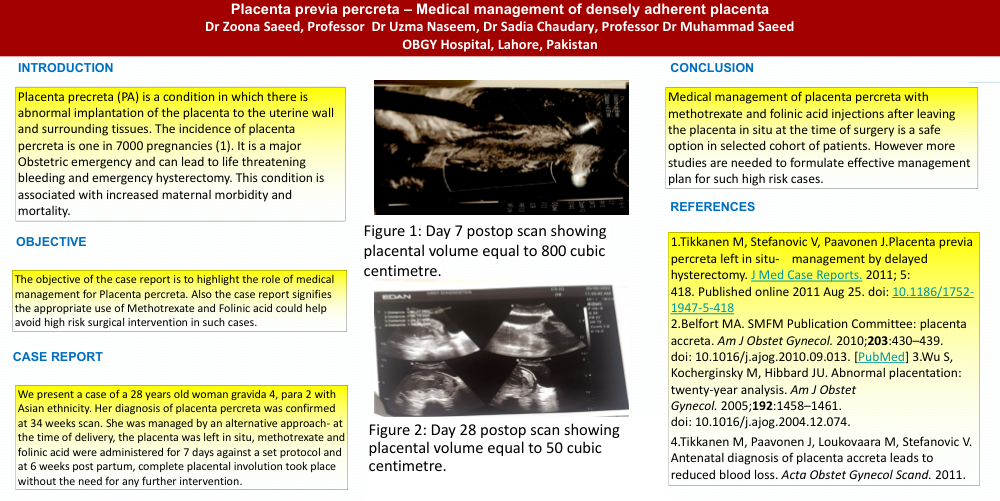
We present a case of a 28 years old woman gravida 4, para 2 with Asian ethinicity. Her diagnosis of placenta percreta was confirmed at 34 weeks scan. She was managed by an alternative approach- at the time of delivery, the placenta was left in situ, methotrexate and folinic acid were administered for 7 days against a set protocol.
Her periodic beta HCG levels showed a decline from 2200 to 1890 to 1500 to 920 to 430 to 170 over the first 4 weeks.
The placental volume decreased from 800 cubic centimeters at the time of delivery to 50 cubic centimeters at the 6th postnatal week.
At 8 weeks gestation and there was no visible placental tissue therefore there was no need for any further intervention or further follow up.
Discussion:
Placenta percreta causes significant maternal morbidity and mortality and can be a major cause of antenatal and postpartum haemorrhage. It can lead to emergency hysterectomy at the time of delivery if the bleeding is not stopped in a timely manner.
There are studies to show that leaving the placenta in situ lowers the risk of hysterectomy and can be an option in cases where conserving fertility is desired.
Our reported case had a diagnosis of placenta percreta in which the placenta was left in situ and the patient was treated with methotrexate and folinic acid injections according to a set protocol and subsequently patient made good postoperative recovery.
At post op 6th week the placental tissue had involuted and patient did not require any further intervention. Uterus was conserved with no morbidity.
In our practice , 2 out of 5 cases had complete placental involution solely with methotrexate and folinic acid injections treatment.
Conclusions:
Medical management of placenta percreta with methotrexate and folinic acid injections after leaving the placenta in situ at the time of surgery is a safe option in selected cohort of patients. However more studies are needed to formulate effective management plan for such high risk cases.