2,281 posters, 63 videos, 56 audios, 43 topics, 18 sessions, 6,174 authors, 2,323 institutions
ePostersLive by SciGen Technologies S.A. All rights reserved.
RCOG World Congress 2025
June 23 - 25, 2025 | ExCeL London, UK
EP.1632
Is gestational diabetes a risk for diabetic retinopathy? Insights from Big Data
Poster Presenter
Part of Topic
Maternal medicine
Audio
Introduction
Gestational diabetes (GDM) affects 4-5% of pregnancies yearly
- associated with a variety of long-term cardiovascular complications
- association with diabetic retinopathy (DR) not well-described in the literature
A pilot study (manuscript submitted) showed that women with GDM had a significant increase in their risk for DR over 10 years vs. women without diabetes.
AIMS
To assess whether a background in GDM augments the risk of long-term DR in a cohort of women with incident diabetes
METHODS
Cohort definition
1)A first observation indicative for diabetes in the primary or secondary care record
2)A first prescription of an anti-diabetic medication
3)A first glycaemic test reaching a diagnostic threshold for diabetes
Statistical analysis
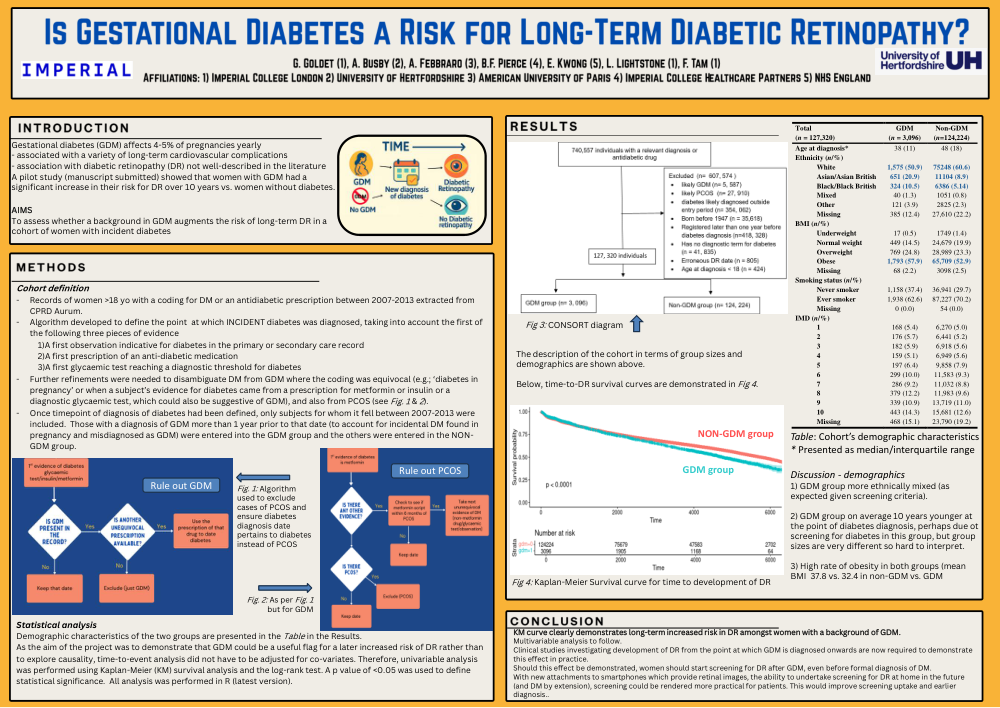
Demographic characteristics of the two groups are presented in the Table in the Results.
As the aim of the project was to demonstrate that GDM could be a useful flag for a later increased risk of DR rather than to explore causality, time-to-event analysis did not have to be adjusted for co-variates. Therefore, univariable analysis was performed using Kaplan-Meier (KM) survival analysis and the log-rank test. A p value of <0.05 was used to define statistical significance. All analysis was performed in R (latest version).
RESULTS
The description of the cohort in terms of group sizes and demographics are shown above.
Below, time-to-DR survival curves are demonstrated in Fig 4.
Discussion - demographics
1) GDM group more ethnically mixed (as expected given screening criteria).
2) GDM group on average 10 years younger at the point of diabetes diagnosis, perhaps due ot screening for diabetes in this group, but group sizes are very different so hard to interpret.
3) High rate of obesity in both groups (mean BMI 37.8 vs. 32.4 in non-GDM vs. GDM
CONCLUSION
KM curve clearly demonstrates long-term increased risk in DR amongst women with a background of GDM.
Multivariable analysis to follow.
Clinical studies investigating development of DR from the point at which GDM is diagnosed onwards are now required to demonstrate this effect in practice.
Should this effect be demonstrated, women should start screening for DR after GDM, even before formal diagnosis of DM.
With new attachments to smartphones which provide retinal images, the ability to undertake screening for DR at home in the future (and DM by extension), screening could be rendered more practical for patients. This would improve screening uptake and earlier diagnosis..