Loading...

2,281 posters, 63 videos, 56 audios, 43 topics, 18 sessions, 6,174 authors, 2,323 institutions

ePostersLive by SciGen Technologies S.A. All rights reserved.

RCOG World Congress 2025

June 23 - 25, 2025 | ExCeL London, UK

EP.1630

Recurrent Pregnancy Loss and Heamatinic Deficiencies
Part of Topic

Maternal medicine

Audio

Absract-

Background: Miscarriage is the loss of a pregnancy before 24weeks gestation with early miscarriage being most common at <12 weeks gestation. Recurrent miscarriage, defined as 3 or more consecutive early miscarriages affects 1 in 100 couples trying to conceive.  During pregnancy, the balance of haematinic micronutrients changes which may affect pregnancy outcomes, especially if the women are deficient. This systematic review and meta-analysis investigated if haematinic micronutrient deficiencies (B12, folate and iron) were associated with recurrent miscarriage and if supplementation improved pregnancy outcomes. 

Methods: A systematic review and meta-analysis of observational studies examined the association between recurrent miscarriage and haematinic deficiencies; and a systematic review of randomised controlled trials planned to investigate the impact of testing and treating haematinic deficiency to improve subsequent pregnancy outcomes in couples with recurrent miscarriage. Data was pooled using the Mantel-Haenszel method to provide odds ratios with 95% confidence intervals. PROSPERO registration number: CRD42024557279.

Results: 11 studies were identified for this review, 5 were eligible for meta-analysis. There were 1699 participants included in this review. Four studies reported an association between B12 deficiency and recurrent miscarriage, no association was found with ferritin or folate. Generally, the study size and quality were poor and lacking sound methodology.

Conclusion: There may be an association with B12 deficiency and recurrent miscarriage, further research is required for this and other haematinic deficiencies in recurrent miscarriage.

Introduction-

This review aimed to understand if women with recurrent miscarriage (RM) were more likely to have haematinic deficiencies (B12, folate and iron) and whether treating them reduces the risk of subsequent miscarriage.

Nutiritonal Deficiencies in Miscarriage:

•The Lancet Series on Miscarriage1 – FBC and treatment for haematinic deficiencies
•Cochrane Review2 – concluded vitamins do not prevent miscarriage
•Replacing micronutrient deficiencies can improve pregnancy outcomes
 
Methods -

The objectives of this review were to:

1. identify if deficiencies in folate, iron and B12 levels were associated with RM
2. to establish if supplementation of folate, iron and B12 improves pregnancy outcomes for women with RM
 
•The search strategy was created in Medline and modified for use within PubMed, Cochrane, clinicaltrials.gov, and EMBASE
•The literature search and data extraction was completed by two independent researchers. Any differences were discussed with a third reviewer. The final search was performed on 5th July 2024 with 11 studies being identified for this review
•Results were summarised and presented using descriptive statistics. Meta-analysis was carried out in studies which had minimal clinical heterogeneity and in which at least five studies could be included, this was done using Revman 5
•Random effects models were used and the Mantel-Haenszel technique was employed to produce pooled odds ratios (95% CI). I2 was used to measure statistical heterogeneity
 
Results-

SERUM AND RED BLOOD CELL (RBC) FOLATE:

•Eight studies assessed serum folate levels. Studies had contradictory conclusions, with some finding folate to be higher in the RM group and some lower.
•Three studies tested RBC folate levels. None showed an association between RBC folate and women with RM. There were two studies which included women who were still on folate supplementation, two studies which didn’t mention if supplementation was controlled for and the final four studies excluded women who had taken folate supplements for a specified period of time before the study. Meta-analysis was deemed inappropriate for studies investigating folate.
 

FERRITIN:

•One study measured ferritin levels and found the levels to be significantly lower in the women with RM. No meta-analysis was completed for ferritin level due to too few studies.
 

VITAMIN B12:

•9 studies compared Vitamin B12 levels in women with RM compared to controls. 6 out of the 9 studies concluded that women with RM have lower average Vitamin B12 levels when compared to controls.
•Five studies out of the nine assessing B12 levels looked at B12 deficiencies between the cases and controls. These studies used varying definitions for B12 deficiency ranging between <270 to <174pg/ml. The study with the highest threshold for B12 deficiency showed no association between B12 deficiency and RM.
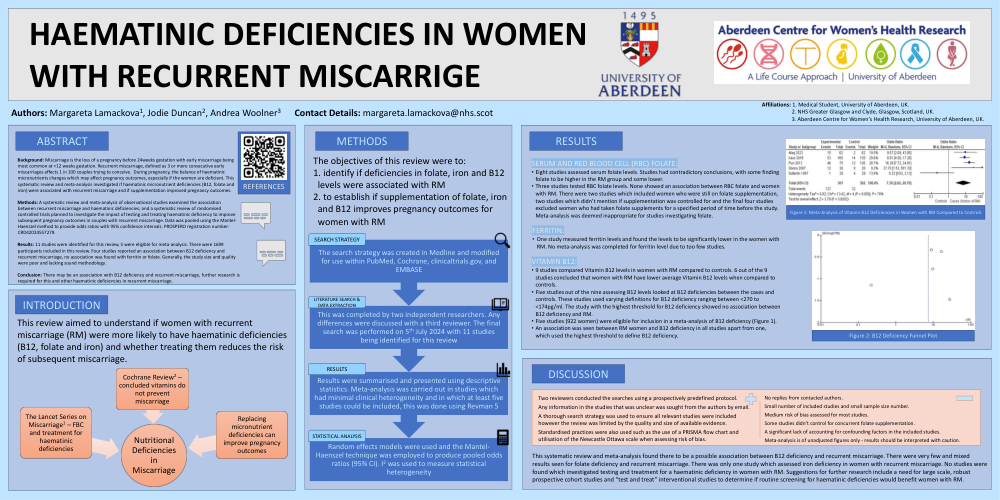
•Five studies (922 women) were eligible for inclusion in a meta-analysis of B12 deficiency (Figure 1).
•An association was seen between RM women and B12 deficiency in all studies apart from one, which used the highest threshold to define B12 deficiency.
 
Discussion- 
 
Strengths:
•Two reviewers conducted the searches using a prospectively predefined protocol.
•Any information in the studies that was unclear was sought from the authors by email.
•A thorough search strategy was used to ensure all relevant studies were included however the review was limited by the quality and size of available evidence.
•Standardised practices were also used such as the use of a PRISMA flow chart and utilisation of the Newcastle Ottawa scale when assessing risk of bias.
 
Limitations:

No replies from contacted authors.

Small number of included studies and small sample size number.

Medium risk of bias assessed for most studies.

Some studies didn’t control for concurrent folate supplementation.

A significant lack of accounting for confounding factors in the included studies.

Meta-analysis is of unadjusted figures only - results should be interpreted with caution.

This systematic review and meta-analysis found there to be a possible association between B12 deficiency and recurrent miscarriage. There were very few and mixed results seen for folate deficiency and recurrent miscarriage. There was only one study which assessed iron deficiency in women with recurrent miscarriage. No studies were found which investigated testing and treatment for a haematinic deficiency in women with RM. Suggestions for further research include a need for large scale, robust prospective cohort studies and “test and treat” interventional studies to determine if routine screening for haematinic deficiencies would benefit women with RM.

Copyright © 2015-2026, ePostersLive® SciGen is a registered trademark of SciGen Technologies S.A. Patent pending.

This website and third-party tools we use rely on cookies for the best user experience. By selecting "I agree", you agree to cookie usage as described in our Privacy Policy.