2,281 posters, 63 videos, 56 audios, 43 topics, 18 sessions, 6,174 authors, 2,323 institutions
ePostersLive by SciGen Technologies S.A. All rights reserved.
RCOG World Congress 2025
June 23 - 25, 2025 | ExCeL London, UK
EP.1628
Platelet function changes during uncomplicated pregnancy and puerperium compared to non-pregnant controls.
Poster Presenter
Authors
Deborah Obeng-Tuudah, Lesley Lanning, Anne Riddell, Keith Gomez, Rezan Abdul Kadir
Affiliations
Department of Haematology, Katharine Dormandy Haemophilia Centre and Thrombosis Unit and Department of Obstetrics and Gynaecology, Royal Free Hospital, Department of Haematology, Katharine Dormandy Haemophilia Centre and Thrombosis Unit, Royal Free Hospital
Part of Topic
Maternal medicine
Platelet function changes during uncomplicated pregnancy and puerperium compared to non-pregnant controls.
D. Obeng-Tuudah 1,2,3, L. Lanning1, A. Riddell 1, K. Gomez 1, R. A. Kadir 1,2
1Department of Haematology, Katharine Dormandy Haemophilia Centre and Thrombosis Unit, Royal Free Hospital, London.
2Department of Obstetrics and Gynaecology, Royal Free Hospital, London.
3EGA Institute for Women’s Health, University College London.
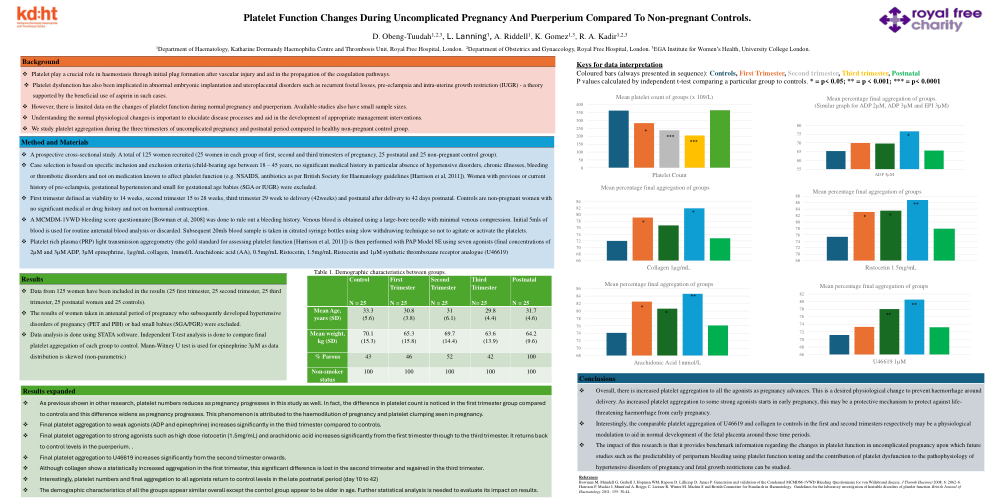
Objective: Platelet play a crucial role in haemostasis through initial plug formation after vascular injury and aiding the propagation of the coagulation pathways. Platelet dysfunction has been implicated in abnormal embryonic implantation and uteroplacental disorders such as recurrent foetal losses, pre-eclampsia and IUGR - a theory supported by the beneficial use of aspirin in such cases. However, there is limited data on the changes of platelet function during normal pregnancy and puerperium. Most studies also have small sample sizes. Understanding the normal physiological changes is important to elucidate disease processes. We study platelet aggregation during the three trimesters of uncomplicated pregnancy and postnatal period compared to healthy non-pregnant group.
Design: A prospective cross-sectional study. A total of 125 women recruited (25 women in each group of first, second and third trimesters of pregnancy, 25 postnatal and 25 non-pregnant control).
Method: Case selection was based on specific inclusion and exclusion criteria e.g. excluding women with history of pre-eclampsia, hypertension, SGA/IUGR babies or on medication. A low bleeding score was confirmed in all participants. Venous blood was obtained and light transmission aggregometry was performed with PAP Model 8E using six agonists (epinephrine, ADP, collagen, ristocetin, arachidonic acid and U46619) at concentrations used to test for platelet function disorders. Data analysis was done using STATA software and independent T-test analysis.
Results: In the first trimester, final platelet aggregation to weak agonists (epinephrine and ADP) was comparable to controls. However, these increased significantly in the third trimester compared to controls. Final platelet aggregation to strong agonists ((collagen, ristocetin and arachidonic acid) increased steadily and significantly from the first trimester through to the third trimester. Final platelet aggregation to U46619 increased significantly from the second trimester onwards. Platelet aggregation to all agonists settled back to non-pregnancy levels in the postnatal period.
Conclusion: Overall, there was increased platelet aggregation to all the agonists as pregnancy advanced. This is a desired physiological change to prevent haemorrhage around delivery. As increased platelet aggregation to some strong agonists started in early pregnancy, this could be a protective mechanism against life-threatening haemorrhage from early pregnancy such as miscarriage.
This research provides benchmark data in changes in platelet function in uncomplicated pregnancy upon which future studies e.g. the predictability of peripartum bleeding using platelet function testing, the contribution of platelet dysfunction to the pathophysiology of hypertensive disorders of pregnancy and fetal growth restrictions can be Studied.