2,281 posters, 63 videos, 56 audios, 43 topics, 18 sessions, 6,174 authors, 2,323 institutions
ePostersLive by SciGen Technologies S.A. All rights reserved.
RCOG World Congress 2025
June 23 - 25, 2025 | ExCeL London, UK
EP.1627
Pregnancy Outcomes in Women with Type 1 and Type 2 Diabetes
Poster Presenter
Authors
Affiliations
Grange University Hospital, Nevill Hall Hospital, Royal Gwent Hospital
Part of Topic
Maternal medicine
Pregnancy Outcomes in Women with Type 1 and Type 2 Diabetes in 2023
Anjali ( Junior Clinical Fellow in Obstetrics and Gynecology)1, Ms Anurag Pinto (Consultant, Obstetrics and Gynecology), Ms Lisa Pilkington (Consultant, Obstetrics and Gynecology)
Objective :
This study evaluates pregnancy outcomes in women with Type 1 and Type 2 diabetes who gave birth in 2023 at Aneurin Bevan Health Board.
It aimed to assess: Maternal and neonatal outcomes, preconception care, glycemic control, adherence to antenatal management, delivery complications
Method:
This was a retrospective audit of diabetic pregnancies that had antenatal care (ANC) in 2022–2023 and resulted in births in 2023. Medical records were reviewed to assess adherence to clinical guidelines, maternal glycemic control, pregnancy complications, and neonatal outcomes.
A total of 57 women were evaluated, including 8 miscarriages and 11 who transferred care to a different health board during the pregnancy.
Final cohort: 38 women with complete ANC (excluding miscarriages) :
21 with Type 1 Diabetes
17 with Type 2 Diabetes
Results:
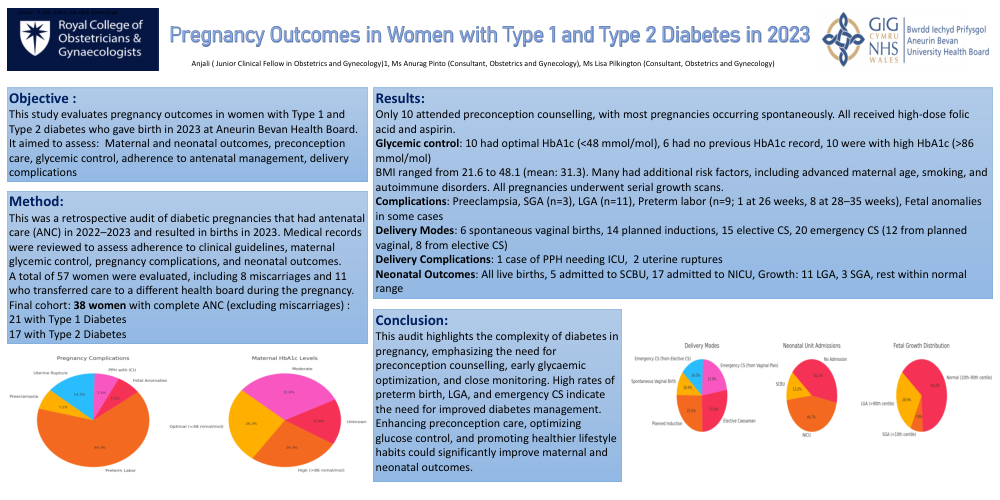
Only 10 attended preconception counselling, with most pregnancies occurring spontaneously. All received high-dose folic acid and aspirin.
Glycemic control: 10 had optimal HbA1c (<48 mmol/mol), 6 had no previous HbA1c record, 10 were with high HbA1c (>86 mmol/mol)
BMI ranged from 21.6 to 48.1 (mean: 31.3). Many had additional risk factors, including advanced maternal age, smoking, and autoimmune disorders. All pregnancies underwent serial growth scans.
Complications: Preeclampsia, SGA (n=3), LGA (n=11), Preterm labor (n=9; 1 at 26 weeks, 8 at 28–35 weeks), Fetal anomalies in some cases
Delivery Modes: 6 spontaneous vaginal births, 14 planned inductions, 15 elective CS, 20 emergency CS (12 from planned vaginal, 8 from elective CS)
Delivery Complications: 1 case of PPH needing ICU, 2 uterine ruptures
Neonatal Outcomes: All live births, 5 admitted to SCBU, 17 admitted to NICU, Growth: 11 LGA, 3 SGA, rest within normal range
Conclusion:
This audit highlights the complexity of diabetes in pregnancy, emphasizing the need for preconception counselling, early glycaemic optimization, and close monitoring. High rates of preterm birth, LGA, and emergency CS indicate the need for improved diabetes management. Enhancing preconception care, optimizing glucose control, and promoting healthier lifestyle habits could significantly improve maternal and neonatal outcomes.