2,281 posters, 63 videos, 56 audios, 43 topics, 18 sessions, 6,174 authors, 2,323 institutions
ePostersLive by SciGen Technologies S.A. All rights reserved.
RCOG World Congress 2025
June 23 - 25, 2025 | ExCeL London, UK
EP.1622
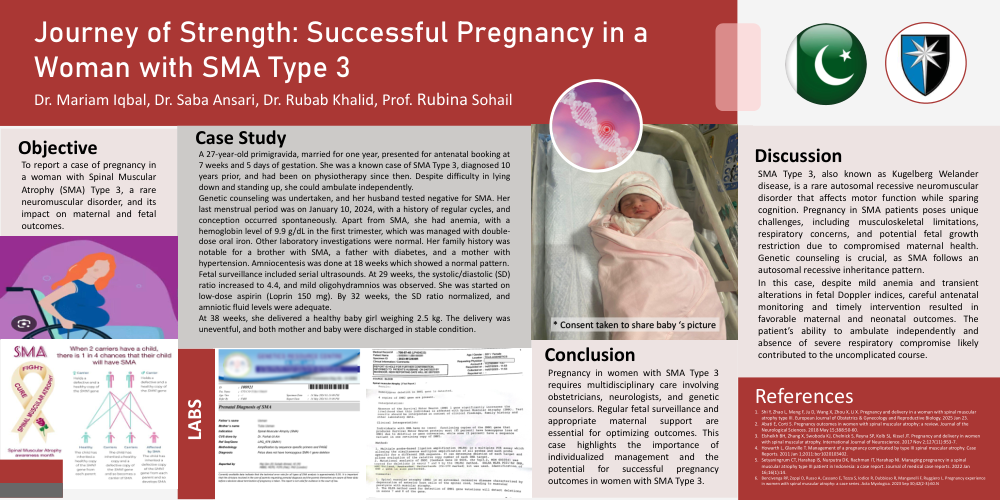
Journey of Strength: Successful Pregnancy in a Woman with SMA Type 3
Poster Presenter
Part of Topic
Maternal medicine
Journey of Strength: Successful Pregnancy in a Woman with SMA Type 3
Objective:
To report a case of pregnancy in a woman with Spinal Muscular Atrophy (SMA) Type 3, a rare neuromuscular disorder, and its impact on maternal and fetal outcomes.
Case Study:
A 27-year-old primigravida, married for one year, presented for antenatal booking at 7 weeks and 5 days of gestation. She was a known case of SMA Type 3, diagnosed 10 years prior, and had been on physiotherapy since then. Despite difficulty in lying down and standing up, she could ambulate independently.
Genetic counseling was undertaken, and her husband tested negative for SMA. Her last menstrual period was on January 10, 2024, with a history of regular cycles, and conception occurred spontaneously. Apart from SMA, she had anemia, with a hemoglobin level of 9.9 g/dL in the first trimester, which was managed with double-dose oral iron. Other laboratory investigations were normal. Her family history was notable for a brother with SMA, a father with diabetes, and a mother with hypertension.
Fetal surveillance included serial ultrasounds. At 29 weeks, the systolic/diastolic (SD) ratio increased to 4.4, and mild oligohydramnios was observed. She was started on low-dose aspirin (Loprin 150 mg). By 32 weeks, the SD ratio normalized, and amniotic fluid levels were adequate.
At 38 weeks, she delivered a healthy baby girl weighing 2.5 kg. The delivery was uneventful, and both mother and baby were discharged in stable condition.
Discussion:
SMA Type 3, also known as Kugelberg-Welander disease, is a rare autosomal recessive neuromuscular disorder that affects motor function while sparing cognition. Pregnancy in SMA patients poses unique challenges, including musculoskeletal limitations, respiratory concerns, and potential fetal growth restriction due to compromised maternal health. Genetic counseling is crucial, as SMA follows an autosomal recessive inheritance pattern.
In this case, despite mild anemia and transient alterations in fetal Doppler indices, careful antenatal monitoring and timely intervention resulted in favorable maternal and neonatal outcomes. The patient’s ability to ambulate independently and absence of severe respiratory compromise likely contributed to the uncomplicated course.
Conclusion:
Pregnancy in women with SMA Type 3 requires multidisciplinary care involving obstetricians, neurologists, and genetic counselors. Regular fetal surveillance and appropriate maternal support are essential for optimizing outcomes. This case highlights the importance of individualized management and the potential for successful pregnancy outcomes in women with SMA Type 3.