2,281 posters, 63 videos, 56 audios, 43 topics, 18 sessions, 6,174 authors, 2,323 institutions
ePostersLive by SciGen Technologies S.A. All rights reserved.
RCOG World Congress 2025
June 23 - 25, 2025 | ExCeL London, UK
EP.1619
Case series of three patients with Anti thrombin III deficiency in pregnancy
Poster Presenter
Authors
Affiliations
Part of Topic
Maternal medicine
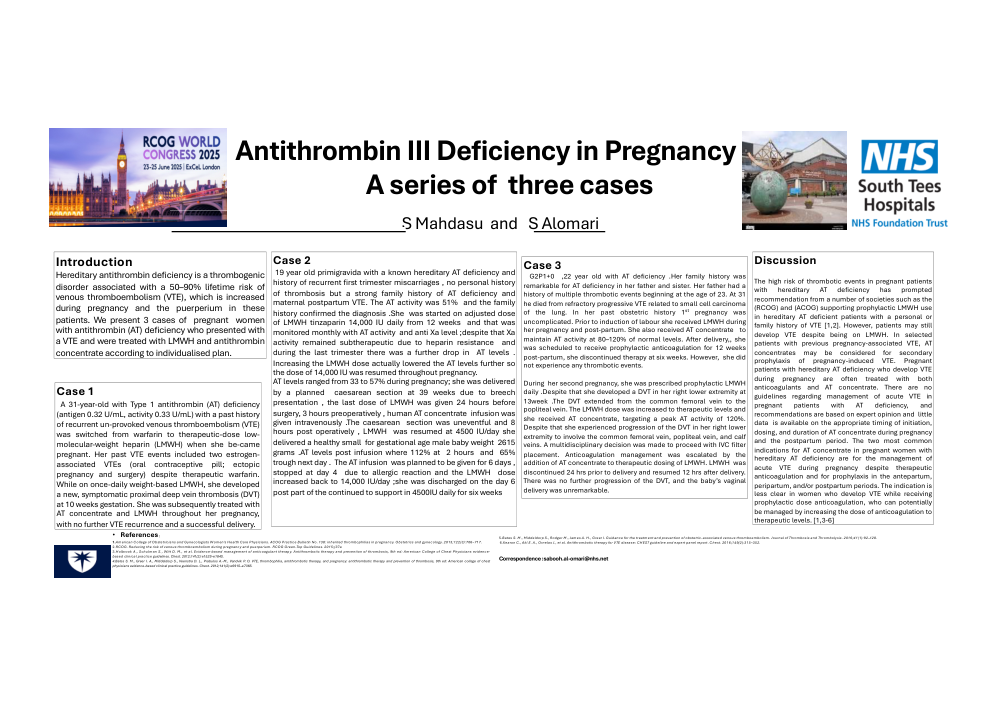
Antithrombin III Deficiency in Pregnancy
A series of three cases
S Mahdasu and S Alomari
Introduction
Hereditary antithrombin deficiency is a thrombogenic
disorder associated with a 50–90% lifetime risk of
venous thromboembolism (VTE), which is increased
during pregnancy and the puerperium in these
patients. We present 3 cases of pregnant women
with antithrombin (AT) deficiency who presented with
a VTE and were treated with LMWH and antithrombin
concentrate according to individualised plan.
Case 1
A 31-year-old with Type 1 antithrombin (AT) deficiency
(antigen 0.32 U/mL, activity 0.33 U/mL) with a past history
of recurrent un-provoked venous thromboembolism (VTE)
was switched from warfarin to therapeutic-dose low-
molecular-weight heparin (LMWH) when she be-came
pregnant. Her past VTE events included two estrogen-
associated VTEs (oral contraceptive pill; ectopic
pregnancy and surgery) despite therapeutic warfarin.
While on once-daily weight-based LMWH, she developed
a new, symptomatic proximal deep vein thrombosis (DVT)
at 10 weeks gestation. She was subsequently treated with
AT concentrate and LMWH throughout her pregnancy,
with no further VTE recurrence and a successful delivery.
Case 2
19 year old primigravida with a known hereditary AT deficiency and
history of recurrent first trimester miscarriages , no personal history
of thrombosis but a strong family history of AT deficiency and
maternal postpartum VTE. The AT activity was 51% and the family
history confirmed the diagnosis .She was started on adjusted dose
of LMWH tinzaparin 14,000 IU daily from 12 weeks and that was
monitored monthly with AT activity and anti Xa level ;despite that Xa
activity remained subtherapeutic due to heparin resistance and
during the last trimester there was a further drop in AT levels .
Increasing the LMWH dose actually lowered the AT levels further so
the dose of 14,000 IU was resumed throughout pregnancy.
AT levels ranged from 33 to 57% during pregnancy; she was delivered
by a planned caesarean section at 39 weeks due to breech
presentation , the last dose of LMWH was given 24 hours before
surgery, 3 hours preoperatively , human AT concentrate infusion was
given intravenously .The caesarean section was uneventful and 8
hours post operatively , LMWH was resumed at 4500 IU/day she
delivered a healthy small for gestational age male baby weight 2615
grams .AT levels post infusion where 112% at 2 hours and 65%
trough next day . The AT infusion was planned to be given for 6 days ,
stopped at day 4 due to allergic reaction and the LMWH dose
increased back to 14,000 IU/day ;she was discharged on the day 6
post part of the continued to support in 4500IU daily for six weeks
Discussion
Case 3
G2P1+0 ,22 year old with AT deficiency .Her family history was
remarkable for AT deficiency in her father and sister. Her father had a
history of multiple thrombotic events beginning at the age of 23. At 31
he died from refractory progressive VTE related to small cell carcinoma
of the lung. In her past obstetric history 1st pregnancy was
uncomplicated. Prior to induction of labour she received LMWH during
her pregnancy and post-partum. She also received AT concentrate to
maintain AT activity at 80–120% of normal levels. After delivery,, she
was scheduled to receive prophylactic anticoagulation for 12 weeks
post-partum, she discontinued therapy at six weeks. However, she did
not experience any thrombotic events.
During her second pregnancy, she was prescribed prophylactic LMWH
daily .Despite that she developed a DVT in her right lower extremity at
13week .The DVT extended from the common femoral vein to the
popliteal vein. The LMWH dose was increased to therapeutic levels and
she received AT concentrate, targeting a peak AT activity of 120%.
Despite that she experienced progression of the DVT in her right lower
extremity to involve the common femoral vein, popliteal vein, and calf
veins. A multidisciplinary decision was made to proceed with IVC filter
placement. Anticoagulation management was escalated by the
addition of AT concentrate to therapeutic dosing of LMWH. LMWH was
discontinued 24 hrs prior to delivery and resumed 12 hrs after delivery.
There was no further progression of the DVT, and the baby’s vaginal
delivery was unremarkable.
The high risk of thrombotic events in pregnant patients
with hereditary AT deficiency has prompted
recommendation from a number of societies such as the
(RCOG) and (ACOG) supporting prophylactic LMWH use
in hereditary AT deficient patients with a personal or
family history of VTE [1,2]. However, patients may still
develop VTE despite being on LMWH. In selected
patients with previous pregnancy-associated VTE, AT
concentrates may be considered for secondary
prophylaxis of pregnancy-induced VTE. Pregnant
patients with hereditary AT deficiency who develop VTE
during pregnancy are often treated with both
anticoagulants and AT concentrate. There are no
guidelines regarding management of acute VTE in
pregnant patients with AT deficiency, and
recommendations are based on expert opinion and little
data is available on the appropriate timing of initiation,
dosing, and duration of AT concentrate during pregnancy
and the postpartum period. The two most common
indications for AT concentrate in pregnant women with
hereditary AT deficiency are for the management of
acute VTE during pregnancy despite therapeutic
anticoagulation and for prophylaxis in the antepartum,
peripartum, and/or postpartum periods. The indication is
less clear in women who develop VTE while receiving
prophylactic dose anticoagulation, who can potentially
be managed by increasing the dose of anticoagulation to
therapeutic levels. [1,3-6]
• References :
1.Am erican C ollege of O bstetricians and G ynecologists W om en's H ealth C are Physicians. ACO G Practice Bulletin N o. 138: inherited throm bophilias in pregnancy. O bstetrics and gynecology. 2013;122(3):706–717.
2.RCO G . Reducing the risk of venous throm boem bolism during pregnancy and puerperium . RCO G G reen-Top G uidelines. 2015;(37a
3.H olbrook A ., Schulm an S., W itt D. M ., et al. Evidence-based m anagem ent of anticoagulant therapy. Antithrom botic therapy and prevention of throm bosis, 9th ed: Am erican C ollege of C hest Physicians evidence-
based clinical practice guidelines. Chest. 2012;141(2):e152S–e184S.
4.Bates S. M., Greer I. A., Middeldorp S., Veenstra D. L., Prabulos A.
-M., Vandvik P . O. VTE, thrombophilia, antithrombotic therapy, and pregnancy: antithrombotic therapy and prevention of thrombosis, 9th ed: American college of chest
physicians evidence-based clinical practice guidelines. Chest. 2012;141(2):e691S–e736S.
5.Bates S. M ., M iddeldorp S., Rodger M ., Jam es A . H ., G reer I. G uidance for the treatm ent and prevention of obstetric -associated venous throm boem bolism . Journal of Throm bosis and Throm bolysis. 2016;41(1):92–128.
levels. [1,3-6]
• References :
1.Am erican C ollege of O bstetricians and G ynecologists W om en's H ealth C are Physicians. ACO G Practice Bulletin N o. 138: inherited throm bophilias in pregnancy. O bstetrics and gynecology. 2013;122(3):706–717.
2.RCO G . Reducing the risk of venous throm boem bolism during pregnancy and puerperium . RCO G G reen-Top G uidelines. 2015;(37a
3.H olbrook A ., Schulm an S., W itt D. M ., et al. Evidence-based m anagem ent of anticoagulant therapy. Antithrom botic therapy and prevention of throm bosis, 9th ed: Am erican C ollege of C hest Physicians evidence-
based clinical practice guidelines. Chest. 2012;141(2):e152S–e184S.
4.Bates S. M., Greer I. A., Middeldorp S., Veenstra D. L., Prabulos A.
-M., Vandvik P . O. VTE, thrombophilia, antithrombotic therapy, and pregnancy: antithrombotic therapy and prevention of thrombosis, 9th ed: American college of chest
physicians evidence-based clinical practice guidelines. Chest. 2012;141(2):e691S–e736S.
5.Bates S. M ., M iddeldorp S., Rodger M ., Jam es A . H ., G reer I. G uidance for the treatm ent and prevention of obstetric -associated venous throm boem bolism . Journal of Throm bosis and Throm bolysis. 2016;41(1):92–128.