2,281 posters, 63 videos, 56 audios, 43 topics, 18 sessions, 6,174 authors, 2,323 institutions
ePostersLive by SciGen Technologies S.A. All rights reserved.
RCOG World Congress 2025
June 23 - 25, 2025 | ExCeL London, UK
EP.1610
The Prevalence of Thyroid Disorders Among Pregnant Women in Omdurman Maternity Hospital.
Poster Presenter
Authors
Affiliations
Part of Topic
Maternal medicine
The Prevalence of Thyroid Disorders Among Pregnant Women in Omdurman Maternity Hospital.
Background: The thyroid gland plays a vital role in body metabolism, through the production of thyroid hormones. The thyroid gland undergoes definite physiological changes during pregnancy. Moderate thyroid enlargement and increased vascularity occurs as a result of pregnancy hormone induced glandular hyperplasia.Thyroid stimulation starts as early as the first trimester by human chorionic gonadotropin hormone (beta-HCG), which shares some structural homology with thyroid-stimulating hormone (TSH). There is also an estrogenic-mediated increase in circulating levels of thyroid-binding globulin (TBG). Furthermore, there is a relative decline in the availability of iodide,secondary to the increased renal clearance and overall losses to foetus and placenta.
Objective: To determine the prevalence of thyroid disorders in pregnant women, analyze their effects on pregnancy outcomes, and evaluate the effectiveness of current management strategies at Omdurman Maternity Hospital, Sudan.
Design: A retrospective, cross-sectional study in the period of December 2019 to December 2020.
Methodology: The study was done in a retrospective case-finding hospital based cross-sectional design where master sheets were used to collect data from the files of participants in Omdurman maternity hospital who met the research criteria. Data was collected and analysed in a descriptive manner using IBM SPSS version 17.0 and data was presented in the form of frequency charts, pie charts and bar charts.
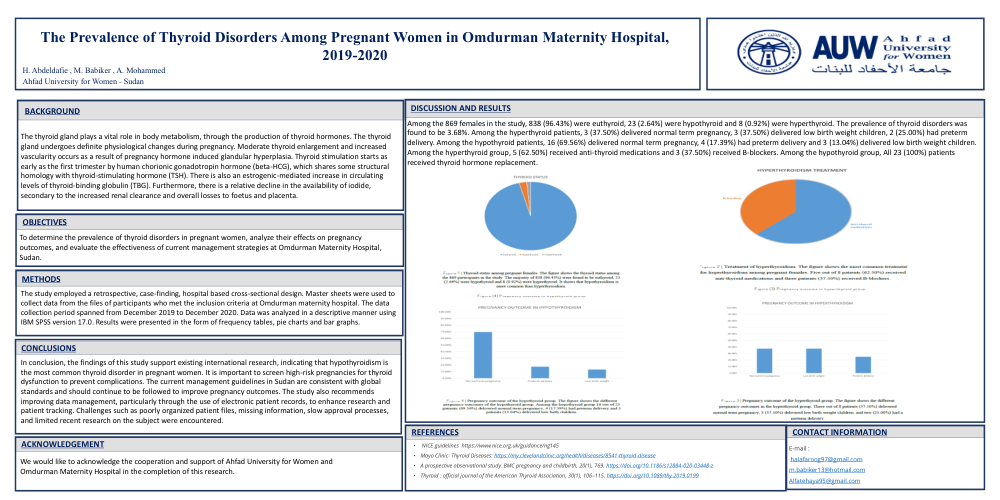
Results: Among the 869 females in the study, 838 (96.43%) were euthyroid, 23 (2.64%) were hypothyroid and 8 (0.92%) were hyperthyroid; in conclusion the prevalence of thyroid disorders was found to be 3.68%. Among the hyperthyroid patients, 3 (37.50%) delivered normal term pregnancy, 3 (37.50%) delivered low birth weight children, 2 (25.00%) had preterm delivery. Among the hypothyroid patients, 16 (69.56%) delivered normal term pregnancy, 4 (17.39%) had preterm delivery and 3 (13.04%) delivered low birth weight children. Among the hyperthyroid group, 5 (62.50%) received anti-thyroid medications and 3 (37.50%) received B-blockers. Among the hypothyroid group, All 23 (100%) patients received thyroid hormone replacement.
Conclusion: In conclusion, the findings of this study support existing international research, indicating that hypothyroidism is the most common thyroid disorder in pregnant women. It is important to screen high-risk pregnancies for thyroid dysfunction to prevent complications. The current management guidelines in Sudan are consistent with global standards and should continue to be followed to improve pregnancy outcomes. The study also recommends improving data management, particularly through the use of electronic patient records, to enhance research and patient tracking. However, challenges such as poorly organized patient files, missing information, slow approval processes, and limited recent research on the subject were encountered.