2,281 posters, 63 videos, 56 audios, 43 topics, 18 sessions, 6,174 authors, 2,323 institutions
ePostersLive by SciGen Technologies S.A. All rights reserved.
RCOG World Congress 2025
June 23 - 25, 2025 | ExCeL London, UK
EP.1609
Maternal and perinatal death surveillance and response implementation in Ethiopia: systematic review
Poster Presenter
Authors
Mohammed Yuya, Abera Kenay Tura, Cato Smulders, Marian Knight, Thomas van den Akker
Affiliations
Haramaya University, Department of International Public Health, Liverpool School of Tropical Medicine, Department of Obstetrics and Gynaecology, Leiden University Medical Center, National Perinatal Epidemiology Unit, University of Oxford
Part of Topic
Maternal medicine
Facilitators and barriers of maternal and perinatal death surveillance and response implementation in Ethiopia: A systematic review
Mohammed Yuya1,2*, Abera Kenay Tura3,4, Cato Smulders2, Marian Knight5, Thomas van den Akker2,6
Introduction
Although Ethiopia was one of the pioneer countries to implement the World Health Organization’s Maternal and Perinatal Death Surveillance and Response (MPDSR) system introduced in 2013 to accelerate the reduction in maternal and perinatal mortality, there has been no systematic evaluation of its implementation in Ethiopia
Objective: to describe uptake, facilitators and barriers to the implementation of MPDSR in Ethiopia
Methods: We searched PubMed, Embase, Web of Science, PubMed Central, and Google Scholar for articles on MPDSR in Ethiopia using relevant key terms. In addition, Google, the Ministry of Health and the Ethiopian Public Health Institute websites were searched for additional data. Articles published before 2013 were excluded from this review. Two authors independently screened and extracted the data. The methodological quality of the studies or reports was assessed using the Joanna Briggs Institute’s quality appraisal tool. For quantitative studies, descriptive analysis and narrative synthesis were conducted; thematic synthesis was used for qualitative studies.
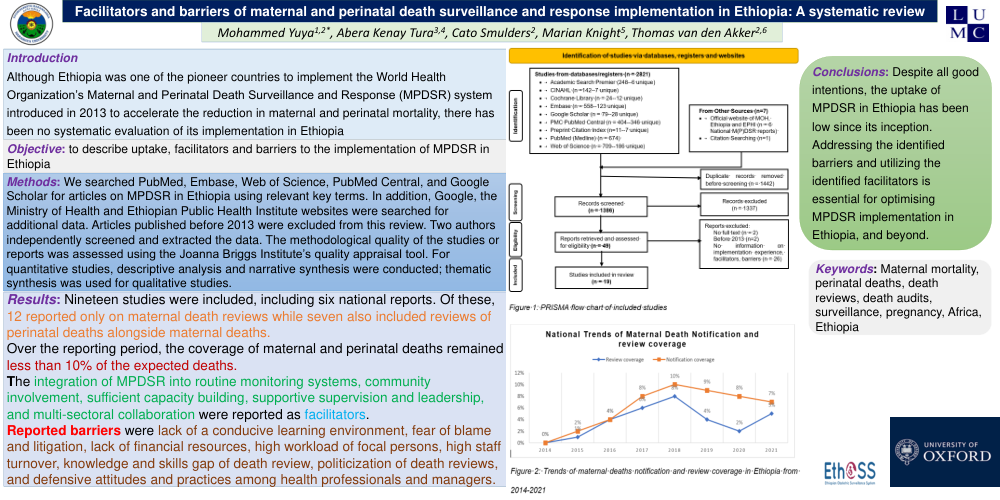
Results: Nineteen studies were included, including six national reports. Of these, 12 reported only on maternal death reviews while seven also included reviews of perinatal deaths alongside maternal deaths. Over the reporting period, the coverage of maternal and perinatal deaths remained less than 10% of the expected deaths. The integration of MPDSR into routine monitoring systems, community involvement, sufficient capacity building, supportive supervision and leadership, and multi-sectoral collaboration were reported as facilitators. Reported barriers were lack of a conducive learning environment, fear of blame and litigation, lack of financial resources, high workload of focal persons, high staff turnover, knowledge and skills gap of death review, politicization of death reviews, and defensive attitudes and practices among health professionals and managers.
Conclusions: Despite all good intentions, the uptake of MPDSR in Ethiopia has been low since its inception. Addressing the identified barriers and utilizing the facilitators is essential for optimising MPDSR implementation in Ethiopia, and beyond.
Keywords: Maternal mortality, perinatal deaths, death reviews, death audits, surveillance, pregnancy, Africa, Ethiopia