2,281 posters, 63 videos, 56 audios, 43 topics, 18 sessions, 6,174 authors, 2,323 institutions
ePostersLive by SciGen Technologies S.A. All rights reserved.
RCOG World Congress 2025
June 23 - 25, 2025 | ExCeL London, UK
EP.1603
An audit evaluating the management of red cell antibody in pregnancy
Poster Presenter
Part of Topic
Maternal medicine
Title: An audit evaluating the management of red cell antibody in pregnancy
Authors: Dr Deepthika Jeyaraman1, Ms Chandrakala Channappa2 and Ms Gomathy Gopal1
Background
Alloimmunisation (Development of maternal red cell antibodies) can lead to Haemolytic Disease of the Foetus and Newborn (HDFN). Anti-D, anti-c, and anti-Kell carry the highest risk of foetal anaemia.1,2 Early identification and monitoring allow for timely intervention by ultrasonography of middle cerebral artery peak systolic velocity Dopplers (MCA PSV), invasive blood tests and intra-uterine/neonatal transfusions to treat anaemia if indicated. This intervention has meant that overall perinatal survival stands at 84% and this audit aims to review our surveillance and management of women at risk of HDFN.1
A previous audit was conducted between January 2018 and January 2019. This reaudit assesses any change since the previous audit.
Aim
To assess the prevalence, management and outcomes of pregnancies affected by red cell antibodies at University Hospital North Midlands NHS Trust and compare the findings with the previous audit.
Methods
A retrospective audit was conducted for 12 months from July 2022 to July 2023. The data was collected from the electronic maternity system (K2, I-portal) and neonatal information system (Badger).
The pregnancies with red cell antibodies based on blood bank screening were identified and used for the data collection. The collected data was analysed using Microsoft Excel and compared with national and local standards.
The data obtained was compared with findings from the previous audit conducted between January 2018 and 2019.
Demographics
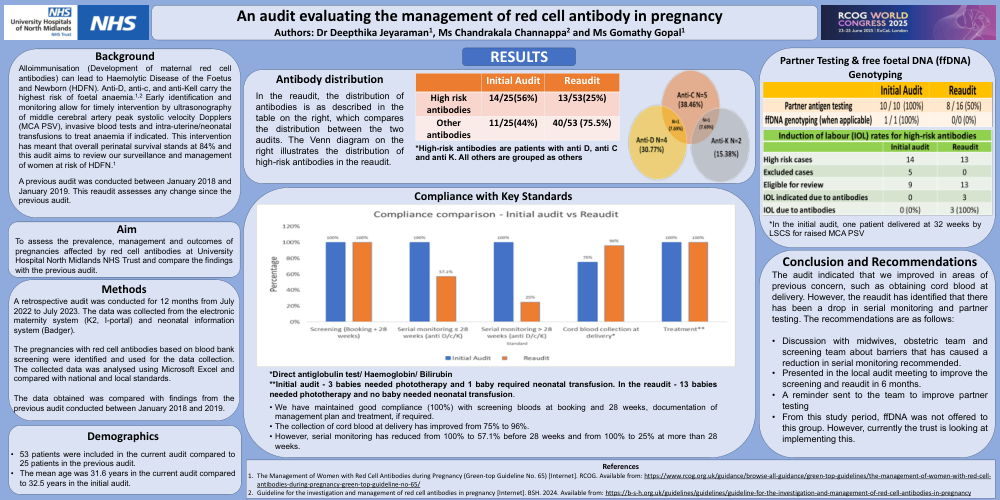
Antibody distribution: In the reaudit, the distribution of antibodies is as described in the table on the right, which compares the distribution between the two audits. The Venn diagram on the right illustrates the distribution of high-risk antibodies in the reaudit.
*High-risk antibodies are patients with anti D, anti C and anti K. All others are grouped as others.
Compliance with Key Standards
*Direct antiglobulin test/ Haemoglobin/ Bilirubin
**Initial audit - 3 babies needed phototherapy and 1 baby required neonatal transfusion. In the reaudit - 13 babies needed phototherapy and no baby needed neonatal transfusion.
Partner Testing & free foetal DNA (ffDNA) Genotyping
*In the initial audit, one patient delivered at 32 weeks by LSCS for raised MCA PSV
Conclusion and Recommendations
The audit indicated that we improved in areas of previous concern, such as obtaining cord blood at delivery. However, the reaudit has identified that there has been a drop in serial monitoring and partner testing. The recommendations are as follows:
•Discussion with midwives, obstetric team and screening team about barriers that has caused a reduction in serial monitoring recommended.
•Presented in the local audit meeting to improve the screening and reaudit in 6 months.
•A reminder sent to the team to improve partner testing
References