2,281 posters, 63 videos, 56 audios, 43 topics, 18 sessions, 6,174 authors, 2,323 institutions
ePostersLive by SciGen Technologies S.A. All rights reserved.
RCOG World Congress 2025
June 23 - 25, 2025 | ExCeL London, UK
EP.1598
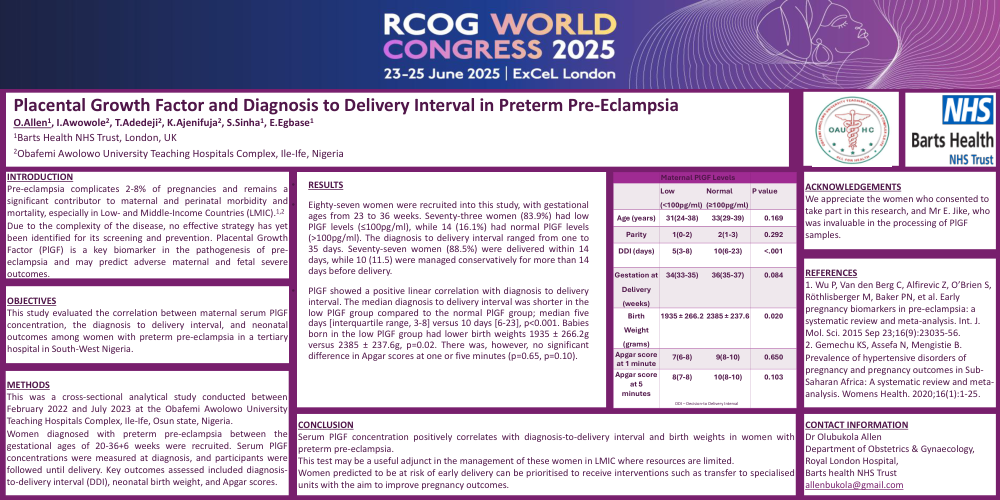
Placental Growth Factor and Diagnosis to Delivery Interval in Preterm Pre-Eclampsia
Poster Presenter
Part of Topic
Maternal medicine
Placental Growth Factor and Diagnosis to Delivery Interval in Preterm Pre-Eclampsia
O.Allen1, I.Awowole2, T.Adedeji2, K.Ajenifuja2, S.Sinha1, E.Egbase1
1Barts Health NHS Trust, London, UK
2Obafemi Awolowo University Teaching Hospitals Complex, Ile-Ife, Nigeria
INTRODUCTION
Pre-eclampsia complicates 2-8% of pregnancies and remains a significant contributor to maternal and perinatal morbidity and mortality, especially in Low- and Middle-Income Countries (LMIC).1,2
Due to the complexity of the disease, no effective strategy has yet been identified for its screening and prevention. Placental Growth Factor (PlGF) is a key biomarker in the pathogenesis of pre-eclampsia and may predict adverse maternal and fetal severe outcomes.
OBJECTIVES
This study evaluated the correlation between maternal serum PlGF concentration, the diagnosis to delivery interval, and neonatal outcomes among women with preterm pre-eclampsia in a tertiary hospital in South-West Nigeria.
METHODS
This was a cross-sectional analytical study conducted between February 2022 and July 2023 at the Obafemi Awolowo University Teaching Hospitals Complex, Ile-Ife, Osun state, Nigeria.
Women diagnosed with preterm pre-eclampsia between the gestational ages of 20-36+6 weeks were recruited. Serum PlGF concentrations were measured at diagnosis, and participants were followed until delivery. Key outcomes assessed included diagnosis-to-delivery interval (DDI), neonatal birth weight, and Apgar scores.
CONCLUSION
Serum PlGF concentration positively correlates with diagnosis-to-delivery interval and birth weights in women with preterm pre-eclampsia.
This test may be a useful adjunct in the management of these women in LMIC where resources are limited.
Women predicted to be at risk of early delivery can be prioritised to receive interventions such as transfer to specialised units with the aim to improve pregnancy outcomes.
REFERENCES
1. Wu P, Van den Berg C, Alfirevic Z, O’Brien S, Röthlisberger M, Baker PN, et al. Early pregnancy biomarkers in pre-eclampsia: a systematic review and meta-analysis. Int. J. Mol. Sci. 2015 Sep 23;16(9):23035-56.
2. Gemechu KS, Assefa N, Mengistie B. Prevalence of hypertensive disorders of pregnancy and pregnancy outcomes in Sub-Saharan Africa: A systematic review and meta-analysis. Womens Health. 2020;16(1):1-25.