2,281 posters, 63 videos, 56 audios, 43 topics, 18 sessions, 6,174 authors, 2,323 institutions
ePostersLive by SciGen Technologies S.A. All rights reserved.
RCOG World Congress 2025
June 23 - 25, 2025 | ExCeL London, UK
EP.1594
Secondary analysis of research on heat-stable carbetocin for preventing postpartum hemorrhage
Poster Presenter
Authors
Sara Rushwan, Arri Coomarasamy, Adam Devall, Jennifer Scott, Metin Gulmezoglu
Affiliations
Part of Topic
Maternal medicine
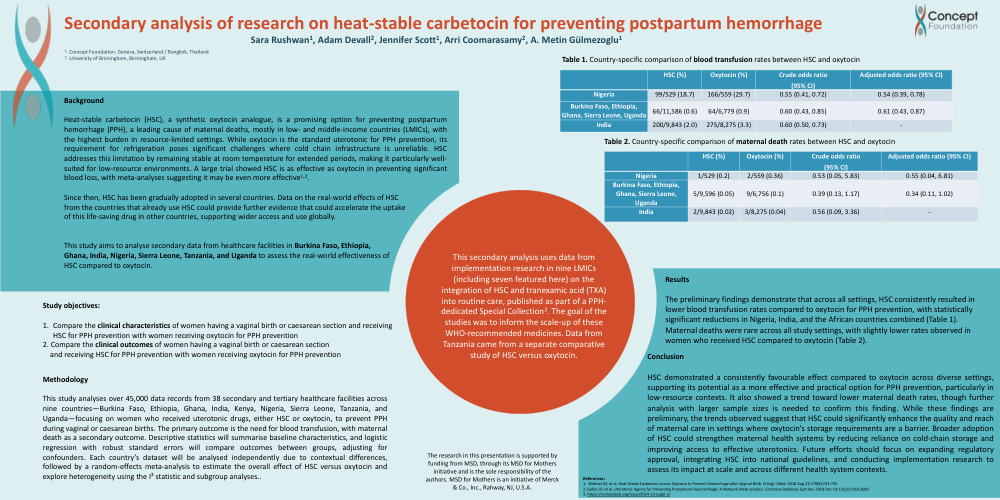
Secondary analysis of research on heat-stable carbetocin for preventing postpartum hemorrhage
Background
Heat-stable carbetocin (HSC), a synthetic oxytocin analogue, is a promising option for preventing postpartum hemorrhage (PPH), a leading cause of maternal deaths, mostly in low- and middle-income countries (LMICs), with the highest burden in resource-limited settings. While oxytocin is the standard uterotonic for PPH prevention, its requirement for refrigeration poses significant challenges where cold chain infrastructure is unreliable. HSC addresses this limitation by remaining stable at room temperature for extended periods, making it particularly well suited for low-resource environments. A large trial showed HSC is as effective as oxytocin in preventing significant blood loss, with meta-analyses suggesting it may be even more effective1,2.
Since then, HSC has been gradually adopted in several countries. Data on the real-world effects of HSC from the countries that already use HSC could provide further evidence that could accelerate the uptake of this life-saving drug in other countries, supporting wider access and use globally.
This study aims to analyse secondary data from healthcare facilities in Burkina Faso, Ethiopia, Ghana, India, Nigeria, Sierra Leone, Tanzania, and Uganda to assess the real-world effectiveness of HSC compared to oxytocin