2,281 posters, 63 videos, 56 audios, 43 topics, 18 sessions, 6,174 authors, 2,323 institutions
ePostersLive by SciGen Technologies S.A. All rights reserved.
RCOG World Congress 2025
June 23 - 25, 2025 | ExCeL London, UK
EP.1587
Hidden in plain sight: paracetamol, normothermia, and missed sepsis.
Poster Presenter
Part of Topic
Maternal medicine
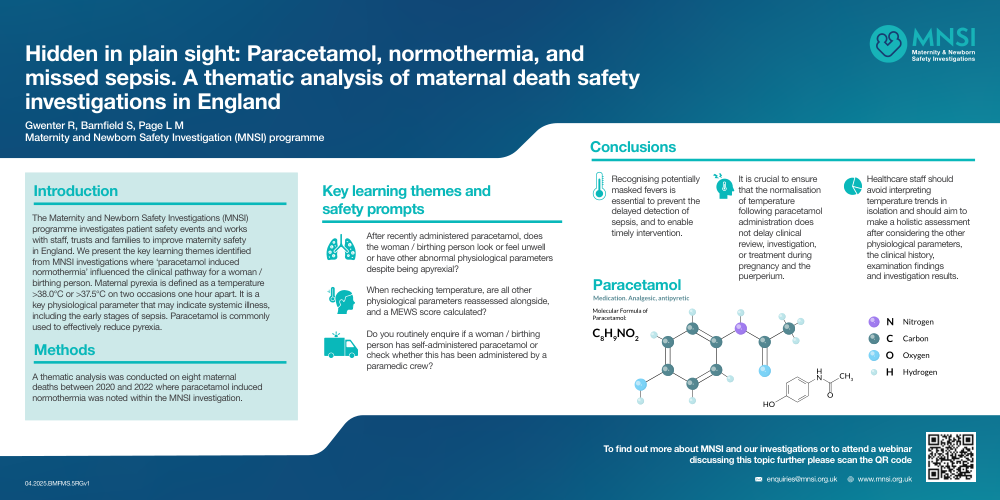
Hidden in plain sight: Paracetamol, normothermia, and missed sepsis. A thematic analysis of maternal death safety investigations in England
Gwenter R, Barnfield S, Page L M
Maternity and Newborn Safety Investigation (MNSI) programme
Introduction
The Maternity and Newborn Safety Investigations (MNSI) programme investigates patient safety events and works with staff, trusts and families to improve maternity safety in England. We present the key learning themes identified from MNSI investigations where ‘paracetamol induced normothermia’ influenced the clinical pathway for a woman / birthing person. Maternal pyrexia is defined as a temperature >38.0°C or >37.5°C on two occasions one hour apart. It is a key physiological parameter that may indicate systemic illness, including the early stages of sepsis. Paracetamol is commonly used to effectively reduce pyrexia.
Methods
A thematic analysis was conducted on eight maternal deaths between 2020 and 2022 where paracetamol induced normothermia was noted within the MNSI investigation.
Key learning themes and safety prompts
- After recently administered paracetamol, does the woman / birthing person look or feel unwell or have other abnormal physiological parameters despite being apyrexial?
- When rechecking temperature, are all other physiological parameters reassessed alongside, and a MEWS score calculated?
- Do you routinely enquire if a woman / birthing person has self-administered paracetamol or check whether this has been administered by a paramedic crew?
Conclusions
Recognising potentially masked fevers is essential to prevent the delayed detection of sepsis, and to enable timely intervention. It is crucial to ensure that the normalisation of temperature following paracetamol administration does not delay clinical review, investigation, or treatment during pregnancy and the puerperium. Healthcare staff should avoid interpreting temperature trends in isolation and should aim to make a holistic assessment after considering the other physiological parameters, the clinical history, examination findings and investigation results