2,281 posters, 63 videos, 56 audios, 43 topics, 18 sessions, 6,174 authors, 2,323 institutions
ePostersLive by SciGen Technologies S.A. All rights reserved.
RCOG World Congress 2025
June 23 - 25, 2025 | ExCeL London, UK
EP.1576
Maternal blood pressure and ethnicty; Interim findings from the BEGOTTEN study
Poster Presenter
Authors
Katie Raphael, Emma Bateman, Elena Greco, Stamatina Iliodromiti, Kate Wiles, Man Ho Kwok, Nawami Jasm, Shalayna Sakaria
Affiliations
Part of Topic
Maternal medicine
A Preliminary Analysis of the BEGOTTEN Study:
Blood pressure patterns in a multi-ethnic pregnancy cohort
Emma Bateman1, Katie Raphael , Manlo Kwok2,3, Nawami Jasm1, Shalayna Sakaria1
1. Queen Mary University of London (QMUL), Barts and the London School of Medicine and Dentistry
2. Women’s Health Research Unit, Wolfson Institute of Population Health, QMUL
3. Barts Health NHS Trust, London, UK
Introduction
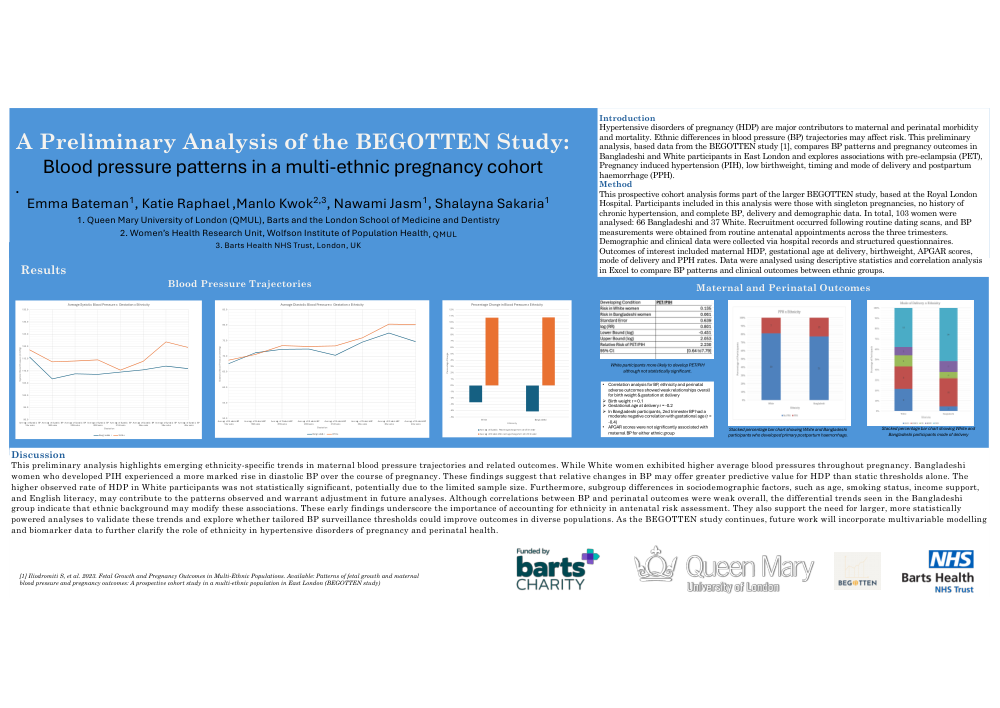
Hypertensive disorders of pregnancy (HDP) are major contributors to maternal and perinatal morbidity and mortality. Ethnic differences in blood pressure (BP) trajectories may affect risk. This preliminary analysis, based data from the BEGOTTEN study [1], compares BP patterns and pregnancy outcomes in Bangladeshi and White participants in East London and explores associations with pre-eclampsia (PET), Pregnancy induced hypertension (PIH), low birthweight, timing and mode of delivery and postpartum haemorrhage (PPH).
Method
This prospective cohort analysis forms part of the larger BEGOTTEN study, based at the Royal London Hospital. Participants included in this analysis were those with singleton pregnancies, no history of chronic hypertension, and complete BP, delivery and demographic data. In total, 103 women were analysed: 66 Bangladeshi and 37 White. Recruitment occurred following routine dating scans, and BP measurements were obtained from routine antenatal appointments across the three trimesters. Demographic and clinical data were collected via hospital records and structured questionnaires. Outcomes of interest included maternal HDP, gestational age at delivery, birthweight, APGAR scores, mode of delivery and PPH rates. Data were analysed using descriptive statistics and correlation analysis in Excel to compare BP patterns and clinical outcomes between ethnic groups.
Discussion
This preliminary analysis highlights emerging ethnicity-specific trends in maternal blood pressure trajectories and related outcomes. While White women exhibited higher average blood pressures throughout pregnancy. Bangladeshi women who developed PIH experienced a more marked rise in diastolic BP over the course of pregnancy. These findings suggest that relative changes in BP may offer greater predictive value for HDP than static thresholds alone. The higher observed rate of HDP in White participants was not statistically significant, potentially due to the limited sample size. Furthermore, subgroup differences in sociodemographic factors, such as age, smoking status, income support, and English literacy, may contribute to the patterns observed and warrant adjustment in future analyses. Although correlations between BP and perinatal outcomes were weak overall, the differential trends seen in the Bangladeshi group indicate that ethnic background may modify these associations. These early findings underscore the importance of accounting for ethnicity in antenatal risk assessment. They also support the need for larger, more statistically powered analyses to validate these trends and explore whether tailored BP surveillance thresholds could improve outcomes in diverse populations. As the BEGOTTEN study continues, future work will incorporate multivariable modelling and biomarker data to further clarify the role of ethnicity in hypertensive disorders of pregnancy and perinatal health.