2,281 posters, 63 videos, 56 audios, 43 topics, 18 sessions, 6,174 authors, 2,323 institutions
ePostersLive by SciGen Technologies S.A. All rights reserved.
RCOG World Congress 2025
June 23 - 25, 2025 | ExCeL London, UK
EP.1575
FREQUENCY OF ADVERSE REACTION IN BOOKED ANTENATAL PATIENTS RECEIVING INTRAVENOUS IRON ISOMALTOSIDE
Poster Presenter
Authors
Affiliations
Part of Topic
Maternal medicine
Video
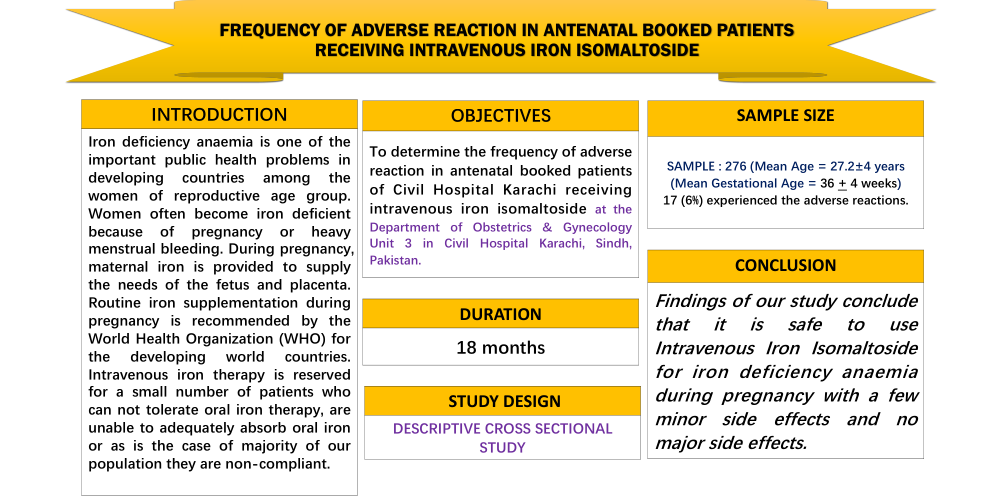
FREQUENCY OF ADVERSE REACTION IN ANTENATAL BOOKED PATIENTS OF CIVIL HOSPITAL KARACHI RECEIVING INTRAVENOUS IRON ISOMALTOSIDE
ABSTRACT
Introduction and Rationale:
Iron deficiency anaemia is one of the important Public Health problems in developing countries among the women of reproductive age group. Women often become iron deficient because of pregnancy or heavy menstrual bleeding. During pregnancy, maternal iron is provided to supply the needs of the fetus and placenta. Routine iron supplementation during pregnancy is recommended by the World Health Organization (WHO) for the developing world countries. Intravenous iron therapy is reserved for a small number of patients who can not tolerate oral iron therapy, are unable to adequately absorb oral iron or as is the case of majority of our population they are non-compliant.
OBJECTIVE
To determine the frequency of adverse reaction in antenatal booked patients of Civil Hospital Karachi receiving intravenous iron isomaltoside.
STUDY DESIGN
Descriptive Cross Sectional Study
SETTING:
Department of Obstetrics and Gynecology Unit III at Civil Hospital Karachi
DURATION
18 months
SAMPLE SIZE: 276
SUBJECTS AND METHOD
Women who weighted < 75 kg at the time of presentation to the antenatal clinic received 1000 mg IV-IIM during a minimum of 15 min. Women with body weighted ≥ 75 kg on the same occasion received 1500 mg IV-IIM during a minimum infusion of 30 min. IIM was diluted in 100–500 ml of saline (typically, 250 ml). Infusions was administered by the researcher. The pregnant woman was placed in a secluded quiet room and directed to lie on her back on a comfortable bed. She was informed about the possibility of a mild, quickly reversible reaction. The researcher monitored the patient during and thirty minutes after the end of infusion to assess the adverse reactions.
RESULTS
The mean age of the women was 27.2 + 4 years, mean gestational age was 36 + 4 weeks. Out of 276 women, 17 (6%) experienced the adverse reactions.
CONCLUSION
Findings of our study conclude that it is safe to use Intravenous Iron Isomaltoside for iron deficiency anaemia during pregnancy with a few minor side effects and no major side effects.