2,281 posters, 63 videos, 56 audios, 43 topics, 18 sessions, 6,174 authors, 2,323 institutions
ePostersLive by SciGen Technologies S.A. All rights reserved.
RCOG World Congress 2025
June 23 - 25, 2025 | ExCeL London, UK
EP.1574
The use of Placental Growth Factor testing to diagnose preterm pre-eclampsia
Poster Presenter
Authors
Affiliations
Part of Topic
Maternal medicine
The Use of Placental Growth Factor Testing to Diagnose Preterm Pre-eclampsia
Introduction
Placental Growth Factor (PlGF) plays a crucial role in managing preterm pre-eclampsia. During 6 to 18 weeks of pregnancy remodelling of the uterine spiral arteries occurs. Failure of this remodelling leads to pre-eclampsia.
This remodelling of the spiral arteries is mediated by angiogenic growth factors such as PlGF. In women who develop pre-eclampsia, PlGF levels are found to be decreased. It is the level of this chemical which helps risk stratify women to appropriately direct surveillance and care provided and optimize the pregnancy outcome.
NICE recommends the use of PlGF testing in the following indications:
• Presentation between 20 – 34+6 weeks
• Isolated new hypertension (>140/90 mmHg)
• Borderline proteinuria (30-50mg/mmol)
• Worsening chronic hypertension /proteinuria in preexisting renal disease/diabetes
• Adjunct to cases with preeclampsia to decide who is likely to need delivery within next two weeks.
Aims
The primary objective of this study is to test the clinical utility of Placental Growth Factor (PlGF) point of care blood testing in the management of suspected preterm pre-eclampsia. Hypothesis: A lower PlGF reading indicates a greater incidence rate of pre-eclampsia and its complications, including preterm birth.
Methods
This study followed an initial pilot study in 2021 which included 34 cases. Cross-sectional observational study using data from a single centre. A total of 77 cases were analysed. The outcome of the PlGF test for each case was recorded. The outcome of the PLGF readings are as follows: high (normal), low (abnormal), very low (abnormal). Indications for testing and risk factors were identified in each case. Complications, including severe pre-eclampsia, HELLP syndrome, pre-term birth, severe fetal growth restriction, abnormal dopplers or pathological CTG during delivery were recorded.
Results
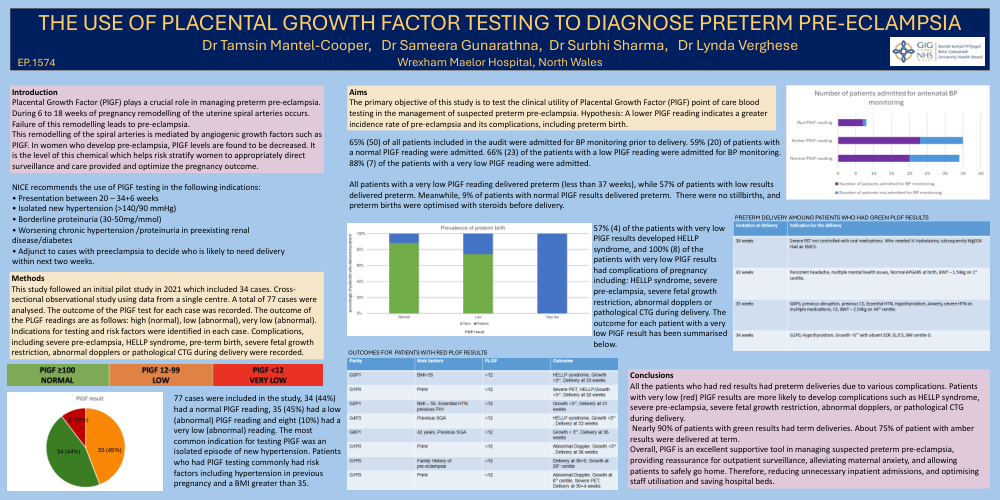
77 cases were included in the study, 34 (44%) had a normal PlGF reading, 35 (45%) had a low (abnormal) PlGF reading and eight (10%) had a very low (abnormal) reading. The most common indication for testing PlGF was an isolated episode of new hypertension. Patients who had PlGF testing commonly had risk factors including hypertension in previous pregnancy and a BMI greater than 35.
5% (50) of all patients included in the audit were admitted for BP monitoring prior to delivery. 59% (20) of patients with a normal PlGF reading were admitted. 66% (23) of the patients with a low PlGF reading were admitted for BP monitoring. 88% (7) of the patients with a very low PlGF reading were admitted.
All patients with a very low PlGF reading delivered preterm (less than 37 weeks), while 57% of patients with low results delivered preterm. Meanwhile, 9% of patients with normal PlGF results delivered preterm. There were no stillbirths, and preterm births were optimised with steroids before delivery.
57% (4) of the patients with very low PlGF results developed HELLP syndrome, and 100% (8) of the patients with very low PlGF results had complications of pregnancy including: HELLP syndrome, severe pre-eclampsia, severe fetal growth restriction, abnormal dopplers or pathological CTG during delivery. The outcome for each patient with a very low PlGF result has been summarised below.
Conclusion
All the patients who had red results had preterm deliveries due to various complications. Patients with very low (red) PlGF results are more likely to develop complications such as HELLP syndrome, severe pre-eclampsia, severe fetal growth restriction, abnormal dopplers, or pathological CTG during delivery.
Nearly 90% of patients with green results had term deliveries. About 75% of patient with amber results were delivered at term.
Overall, PlGF is an excellent supportive tool in managing suspected preterm pre-eclampsia, providing reassurance for outpatient surveillance, alleviating maternal anxiety, and allowing patients to safely go home. Therefore, reducing unnecessary inpatient admissions, and optimising staff utilisation and saving hospital beds.