2,281 posters, 63 videos, 56 audios, 43 topics, 18 sessions, 6,174 authors, 2,323 institutions
ePostersLive by SciGen Technologies S.A. All rights reserved.
RCOG World Congress 2025
June 23 - 25, 2025 | ExCeL London, UK
EP.1571
Maternal complete heart block in pregnancy: A Systematic Review and Meta-analysis
Part of Topic
Maternal medicine
Title: Maternal complete heart block in pregnancy: A Systematic Review and Meta-analysis
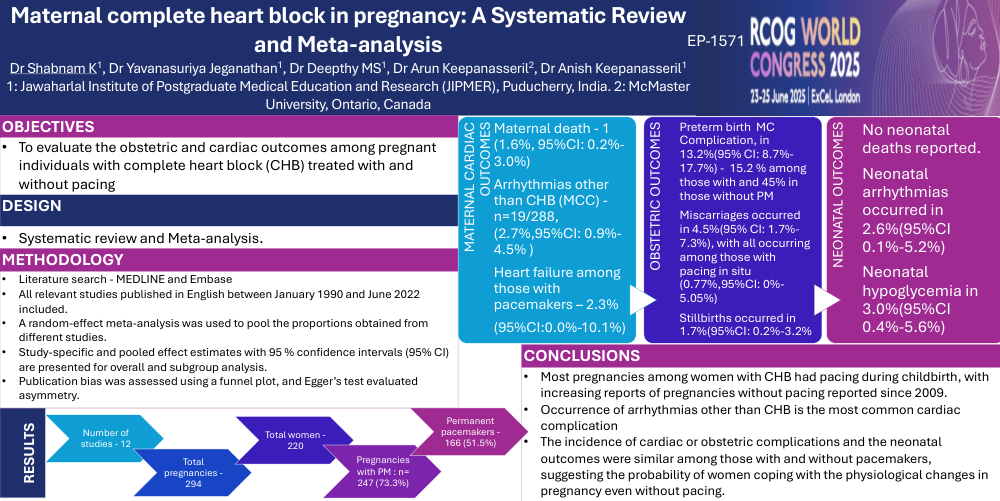
Objectives : To evaluate the obstetric and cardiac outcomes among pregnant individuals with complete heart block (CHB) treated with and without pacing
Design: Systematic review and meta-analysis
Methology:
•Literature search - MEDLINE and Embase
•All relevant studies published in English between January 1990 and June 2022 included.
•A random-effect meta-analysis was used to pool the proportions obtained from different studies.
•Study-specific and pooled effect estimates with 95 % confidence intervals (95% CI) are presented for overall and subgroup analysis.
Publication bias was assessed using a funnel plot, and Egger’s test evaluated asymmetry
Results:
Maternal cardiac outcomes :
•Maternal death - 1 (1.6%, 95%CI: 0.2%-3.0%)
•Arrhythmias other than CHB (MCC) - n=19/288, (2.7%,95%CI: 0.9%-4.5% )
•Heart failure among those with pacemakers – 2.3% (95%CI:0.0%-10.1%)
Obstetric outcomes:
•Preterm birth MC Complication, in 13.2%(95% CI: 8.7%-17.7%) - 15.2 % among those with and 45% in those without PM
•Miscarriages occurred in 4.5%(95% CI: 1.7%-7.3%), with all occurring among those with pacing in situ (0.77%,95%CI: 0%-5.05%)
•Stillbirths occurred in 1.7%(95%CI: 0.2%-3.2%
Neonatal outcomes:
•No neonatal deaths reported.
•Neonatal arrhythmias occurred in 2.6%(95%CI 0.1%-5.2%)
•Neonatal hypoglycemia in 3.0%(95%CI 0.4%-5.6%)
Conclusions:
•Most pregnancies among women with CHB had pacing during childbirth, with increasing reports of pregnancies without pacing reported since 2009.
•Occurrence of arrhythmias other than CHB is the most common cardiac complication
•The incidence of cardiac or obstetric complications and the neonatal outcomes were similar among those with and without pacemakers, suggesting the probability of women coping with the physiological changes in pregnancy even without pacing.