2,281 posters, 63 videos, 56 audios, 43 topics, 18 sessions, 6,174 authors, 2,323 institutions
ePostersLive by SciGen Technologies S.A. All rights reserved.
RCOG World Congress 2025
June 23 - 25, 2025 | ExCeL London, UK
EP.1570
Management of cardiac disease in pregnancy at district general hospital: MDT Approach
Poster Presenter
Authors
Affiliations
Part of Topic
Maternal medicine
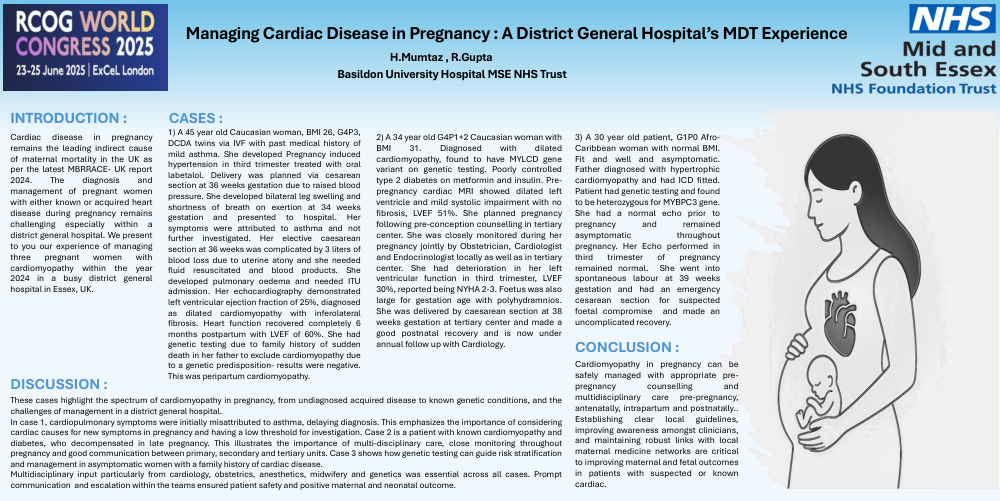
Managing Cardiac Disease in Pregnancy : A District General Hospital’s MDT Experience
H.Mumtaz , R.Gupta
Basildon University Hospital MSE NHS
INTRODUCTION :
Cardiac disease in pregnancy remains the leading indirect cause of maternal mortality in the UK as per the latest MBRRACE- UK report 2024. The diagnosis and management of pregnant women with either known or acquired heart disease during pregnancy remains challenging especially within a district general hospital. We present to you our experience of managing three pregnant women with cardiomyopathy within the year 2024 in a busy district general hospital in Essex, UK.
CASES :
1) A 45 year old Caucasian woman, BMI 26, G4P3, DCDA twins via IVF with past medical history of mild asthma. She developed Pregnancy induced hypertension in third trimester treated with oral labetalol. Delivery was planned via cesarean section at 36 weeks gestation due to raised blood pressure. She developed bilateral leg swelling and shortness of breath on exertion at 34 weeks gestation and presented to hospital. Her symptoms were attributed to asthma and not further investigated. Her elective caesarean section at 36 weeks was complicated by 3 liters of blood loss due to uterine atony and she needed fluid resuscitated and blood products. She developed pulmonary oedema and needed ITU admission. Her echocardiography demonstrated left ventricular ejection fraction of 25%, diagnosed as dilated cardiomyopathy with inferolateral fibrosis. Heart function recovered completely 6 months postpartum with LVEF of 60%. She had genetic testing due to family history of sudden death in her father to exclude cardiomyopathy due to a genetic predisposition- results were negative. This was peripartum cardiomyopathy.
2) A 34 year old G4P1+2 Caucasian woman with BMI 31. Diagnosed with dilated cardiomyopathy, found to have MYLCD gene variant on genetic testing. Poorly controlled type 2 diabetes on metformin and insulin. Pre-pregnancy cardiac MRI showed dilated left ventricle and mild systolic impairment with no fibrosis, LVEF 51%. She planned pregnancy following pre-conception counselling in tertiary center. She was closely monitored during her pregnancy jointly by Obstetrician, Cardiologist and Endocrinologist locally as well as in tertiary center. She had deterioration in her left ventricular function in third trimester, LVEF 30%, reported being NYHA 2-3. Foetus was also large for gestation age with polyhydramnios. She was delivered by caesarean section at 38 weeks gestation at tertiary center and made a good postnatal recovery and is now under annual follow up with Cardiology.
3) A 30 year old patient, G1P0 Afro-Caribbean woman with normal BMI. Fit and well and asymptomatic. Father diagnosed with hypertrophic cardiomyopathy and had ICD fitted. Patient had genetic testing and found to be heterozygous for MYBPC3 gene. She had a normal echo prior to pregnancy and remained asymptomatic throughout pregnancy. Her Echo performed in third trimester of pregnancy remained normal. She went into spontaneous labour at 39 weeks gestation and had an emergency cesarean section for suspected foetal compromise and made an uncomplicated recovery.
DISCUSSION :
These cases highlight the spectrum of cardiomyopathy in pregnancy, from undiagnosed acquired disease to known genetic conditions, and the challenges of management in a district general hospital.
In case 1, cardiopulmonary symptoms were initially misattributed to asthma, delaying diagnosis. This emphasizes the importance of considering cardiac causes for new symptoms in pregnancy and having a low threshold for investigation. Case 2 is a patient with known cardiomyopathy and diabetes, who decompensated in late pregnancy. This illustrates the importance of multi-disciplinary care, close monitoring throughout pregnancy and good communication between primary, secondary and tertiary units. Case 3 shows how genetic testing can guide risk stratification and management in asymptomatic women with a family history of cardiac disease.
Multidisciplinary input particularly from cardiology, obstetrics, anesthetics, midwifery and genetics was essential across all cases. Prompt communication and escalation within the teams ensured patient safety and positive maternal and neonatal outcome.
CONCLUSION :
Cardiomyopathy in pregnancy can be safely managed with appropriate pre-pregnancy counselling and multidisciplinary care pre-pregnancy, antenatally, intrapartum and postnatally.. Establishing clear local guidelines, improving awareness amongst clinicians, and maintaining robust links with local maternal medicine networks are critical to improving maternal and fetal outcomes in patients with suspected or known cardiac.