2,281 posters, 63 videos, 56 audios, 43 topics, 18 sessions, 6,174 authors, 2,323 institutions
ePostersLive by SciGen Technologies S.A. All rights reserved.
RCOG World Congress 2025
June 23 - 25, 2025 | ExCeL London, UK
EP.1567
Impact of COVID 19 in pregnant women with comorbidities in preterm deliveries
Poster Presenter
Part of Topic
Maternal medicine
Title: Impact of COVID-19 in pregnant women with Co-morbidities in preterm deliveries
Introduction:
Background:
The COVID-19 pandemic has imposed significant health challenges worldwide. Pregnant women, particularly those with co-morbidities, are at an elevated risk of adverse outcomes such as preterm deliveries. Limited data is available on the specific impact of COVID-19 on this vulnerable group in Bangladesh. This study aims to fill this gap by examining the incidence of preterm deliveries and associated maternal and neonatal outcomes among pregnant women with co-morbidities in the context of COVID-19 using retrospective data.
Rationale:
Understanding the impact of COVID-19 on pregnant women with co-morbidities can guide healthcare providers in managing these high-risk pregnancies more effectively. The findings also inform public health strategies to mitigate risks and improve outcomes in this population.
Objectives:
Primary Objective:
To evaluate the impact of COVID-19 on the incidence of preterm deliveries in pregnant women with co-morbidities.
Secondary Objectives:
To assess the maternal complications associated with COVID-19 in pregnant women with co-morbidities.
To evaluate the neonatal outcomes of pregnancies complicated by COVID-19 and maternal co-morbidities.
o identify predictors of preterm deliveries and adverse maternal and neonatal outcomes in this population.
Methods:
Study Design:
Retrospective observational study.
Study Setting:
Major tertiary care hospitals across Bangladesh.
Study Population:
Pregnant women diagnosed with COVID-19 and having one or more co-morbidities (e.g., hypertension, diabetes, obesity) who delivered at selected hospitals in Bangladesh from March 2020 to December 2021.
Inclusion Criteria:
Pregnant women aged 24-37 years.
Confirmed COVID-19 infection (positive RT-PCR test) during pregnancy.
Presence of co-morbidities.
Exclusion Criteria:
Multiple pregnancies.
Significant medical or surgical conditions unrelated to pregnancy.
Sample Size:
A sample size of approximately 200 participants targeted to ensure statistical power for detecting differences in outcomes.
Data Collection:
Data collected from existing medical records and hospital databases. The following information extracted:
Demographic Information:
Age
Occupation
Clinical History and Co-morbidities:
Gravida
Para
Gestational age at diagnosis of COVID-19
Type and severity of co-morbidities
Pre-pregnancy BMI
COVID-19 Infection Details:
Date of diagnosis
Symptoms experienced
Severity of COVID-19
Treatment received
Duration of illness
Pregnancy and Delivery Outcomes:
Type of delivery
Gestational age at delivery
Birth weight
Apgar scores
Neonatal complications
Maternal complications
Length of hospital stay for mother and baby
Follow-up and Outcomes:
Maternal and neonatal health at discharge and at follow-up visits
Ongoing symptoms or health issues
Data Analysis
Descriptive statistics used to summarize demographic and clinical characteristics. A correlation between COVID-19 and preterm will be established using explainable AI. Different machine learning models applied to develop a predictive model and a comparative analysis conducted to identify predictors of preterm delivery and adverse outcomes.
Ethical Considerations:
The study conducted in accordance with the Declaration of Helsinki. Ethical approval obtained from the institutional review board of participating hospital. As the study involves retrospective data collection, patient consent may be waived; however, data anonymized to protect patient confidentiality.
Outcomes:
This study provides valuable insights into the impact of COVID-19 on pregnant women with co-morbidities in Bangladesh. It highlights the incidence and predictors of preterm deliveries and other adverse outcomes, contributing to better clinical management and public health strategies for this vulnerable population.
Timeline:
The study is conducted over a period of 8 months.
Results:
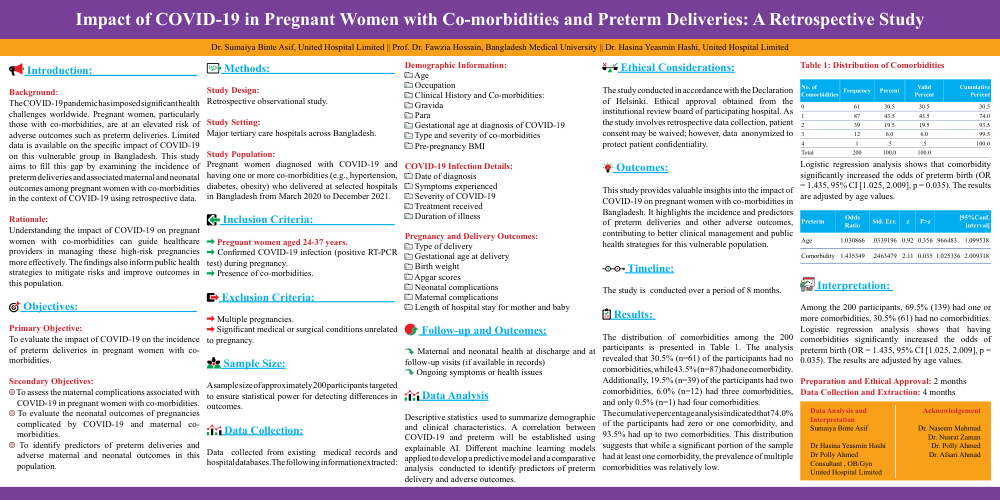
The distribution of comorbidities among the 200 participants is presented in Table 1. The analysis revealed that 30.5% (n=61) of the participants had no comorbidities, while 43.5% (n=87) had one comorbidity. Additionally, 19.5% (n=39) of the participants had two comorbidities, 6.0% (n=12) had three comorbidities, and only 0.5% (n=1) had four comorbidities.
The cumulative percentage analysis indicated that 74.0% of the participants had zero or one comorbidity, and 93.5% had up to two comorbidities. This distribution suggests that while a significant portion of the sample had at least one comorbidity, the prevalence of multiple comorbidities was relatively low.
Logistic regression analysis shows that comorbidity significantly increased the odds of preterm birth (OR = 1.435, 95% CI [1.025, 2.009], p = 0.035). The results are adjusted by age value
Interpretation:
Among the 200 participants, 69.5% (139) had one or more comorbidities, 30.5% (61) had no comorbidities. Logistic regression analysis shows that having comorbidities significantly increased the odds of preterm birth (OR = 1.435, 95% CI [1.025, 2.009], p = 0.035). The results are adjusted by age values.
Preparation
Sumaiya Binte Asif
United Hospital Limited,
Prof Fawzia Hossain
Professor Bangladesh medical university
Dr Hasina Yeasmin Hashi
United Hospital Limited