2,281 posters, 63 videos, 56 audios, 43 topics, 18 sessions, 6,174 authors, 2,323 institutions
ePostersLive by SciGen Technologies S.A. All rights reserved.
RCOG World Congress 2025
June 23 - 25, 2025 | ExCeL London, UK
EP.1565
The Role of Umbilical Cord Thickness as a Predictor of Fetal Macrosomia
Poster Presenter
Authors
Affiliations
Part of Topic
Maternal medicine
INTRODUCTION/BG
- The umbilical cord plays a crucial role in the fetoplacental unit as it facilitates both fetal growth and development inside the womb, a lifeline due to its connection between the fetus and the placenta, which enables proper vascular flow. This serves as a key structure in assessing maternal-fetal health and determining pregnancy outcomes. A fully developed umbilical cord typically appears pearly white, measuring approximately 50-60 cm in length with an average diameter of 1-2 cm.
- Wharton’s jelly plays an important role in the maintenance of adequate blood flow to the fetus. Thus, the study by Barbieri et al., (2011) noted that the area of WJ expands with gestational age until approximately 32 weeks, after which it remains relatively stable until birth. Alterations in WJ and umbilical cord dimensions may indicate potential pregnancy complications.
OBJECTIVES/AIMS
- This study aims determine the correlation of umbilical cord thickness (diameter) and fetal birth weight upon delivery as a predictor of fetal macrosomia. The determination of relationship requires an establishment of reference ranges for the normal population.
-
METHODS
- A prospective cohort study design with non-probability sampling technique was employed, with a total of 90 pregnant participants. The study utilized umbilical cord thickness (diameter) measured via ultrasonography as the index test and neonatal birth weight recorded immediately after delivery as the reference standard. The index test involved measuring the umbilical cord diameter vertically in the longitudinal section adjacent to the junction of the cord with the fetal abdomen. To ensure accuracy, the electronic calipers were placed on the outer-to-outer borders of the umbilical cord during scanning.
- The diagnostic accuracy of umbilical cord thickness in predicting neonatal birth weight was assessed using the Statistical Packages for the Social Sciences (SPSS) version 30. Sensitivity, specificity, positive predictive value (PPV), and negative predictive value (NPV) were calculated from a 2×2 contingency table to evaluate the test's performance. The cut-off value for umbilical cord thickness was pre-specified at 0.76 cm to classify neonatal birth weight categories. Receiver operating characteristic (ROC) curve analysis was performed to determine the overall diagnostic accuracy, with the area under the curve (AUC) calculated to summarize the test's discriminatory ability.
RESULTS
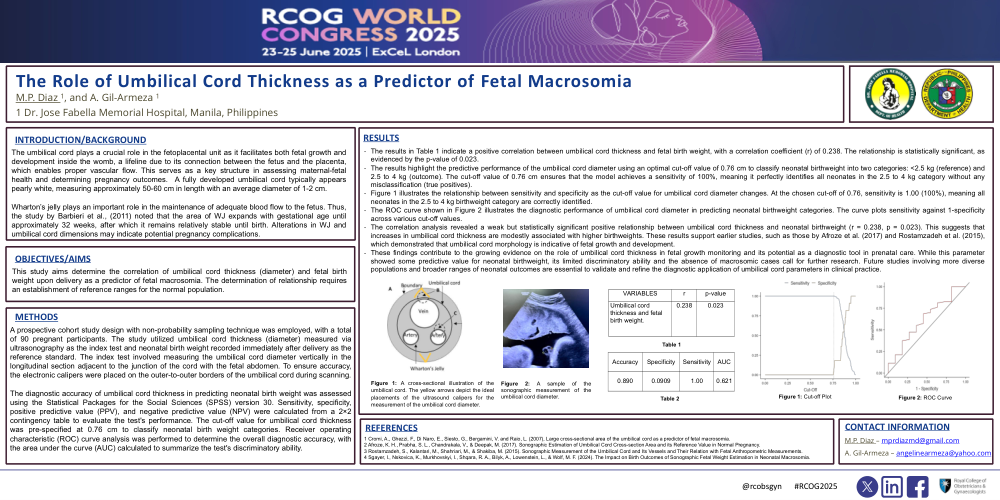
- The results in Table 1 indicate a positive correlation between umbilical cord thickness and fetal birth weight, with a correlation coefficient (r) of 0.238. The relationship is statistically significant, as evidenced by the p-value of 0.023.
- The results highlight the predictive performance of the umbilical cord diameter using an optimal cut-off value of 0.76 cm to classify neonatal birthweight into two categories: <2.5 kg (reference) and 2.5 to 4 kg (outcome). The cut-off value of 0.76 cm ensures that the model achieves a sensitivity of 100%, meaning it perfectly identifies all neonates in the 2.5 to 4 kg category without any misclassification (true positives).
- Figure 1 illustrates the relationship between sensitivity and specificity as the cut-off value for umbilical cord diameter changes. At the chosen cut-off of 0.76, sensitivity is 1.00 (100%), meaning all neonates in the 2.5 to 4 kg birthweight category are correctly identified.
- The ROC curve shown in Figure 2 illustrates the diagnostic performance of umbilical cord diameter in predicting neonatal birthweight categories. The curve plots sensitivity against 1-specificity across various cut-off values.
- The correlation analysis revealed a weak but statistically significant positive relationship between umbilical cord thickness and neonatal birthweight (r = 0.238, p = 0.023). This suggests that increases in umbilical cord thickness are modestly associated with higher birthweights. These results support earlier studies, such as those by Afroze et al. (2017) and Rostamzadeh et al. (2015), which demonstrated that umbilical cord morphology is indicative of fetal growth and development.
- These findings contribute to the growing evidence on the role of umbilical cord thickness in fetal growth monitoring and its potential as a diagnostic tool in prenatal care. While this parameter showed some predictive value for neonatal birthweight, its limited discriminatory ability and the absence of macrosomic cases call for further research. Future studies involving more diverse populations and broader ranges of neonatal outcomes are essential to validate and refine the diagnostic application of umbilical cord parameters in clinical practice.