2,281 posters, 63 videos, 56 audios, 43 topics, 18 sessions, 6,174 authors, 2,323 institutions
ePostersLive by SciGen Technologies S.A. All rights reserved.
RCOG World Congress 2025
June 23 - 25, 2025 | ExCeL London, UK
EP.1563
ASYMPTOMATIC BACTERIURIA IN PREGNANCY: A LONGITUDINAL DESCRIPTIVE STUDY
Part of Topic
Maternal medicine
ASYMPTOMATIC BACTERIURIA IN PREGNANCY: A LONGITUDINAL DESCRIPTIVE STUDY
Rajayohan T, Kandauda C, Madugalle MEMYDB, Liyanapathirana V, Tennagedara AL
Introduction
•Presence of Significant number of bacteria in the urine without symptoms.
•Affects 2-7% of pregnant women.
•Associated with maternal and foetal adverse outcome.
•
Objectives
•To determine the rate of asymptomatic bacteriuria (ABU) in pregnancy
•To describe the risk factors associated with ABU in pregnancy
•To describe the common causative organisms and their antibiotic sensitivity pattern
• To determine the cure rate following treatment with sensitive antibiotics
Design
• This is a longitudinal descriptive study.
METHOD
•411 Pregnant women attending the antenatal clinic for booking visit in Teaching Hospital Peradeniya, Sri Lanka were recruited
•Educated on how to collect midstream clean catch urine sample with a leaflet
•A colony count of more than 105 per ml of urine was considered a culture positive.
•Culture positive samples further underwent antibiotic sensitivity testing.
•Culture positive women were treated with sensitive antibiotics for 7 days and another urine culture was performed in one week to confirm the cure.
RESULTS
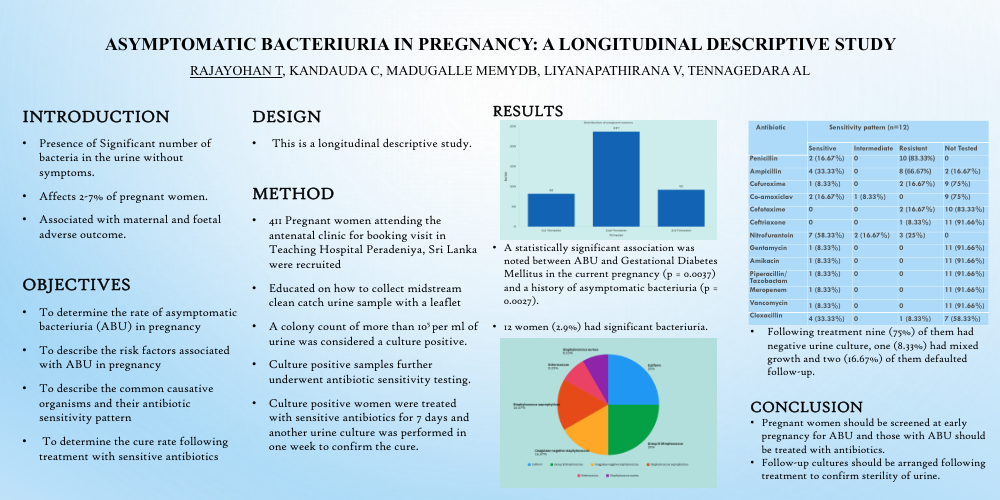
•A statistically significant association was noted between ABU and Gestational Diabetes Mellitus in the current pregnancy (p = 0.0037) and a history of asymptomatic bacteriuria (p = 0.0027).
•12 women (2.9%) had significant bacteriuria.
•Following treatment nine (75%) of them had negative urine culture, one (8.33%) had mixed growth and two (16.67%) of them defaulted follow-up.
CONCLUSION
•Pregnant women should be screened at early pregnancy for ABU and those with ABU should be treated with antibiotics.
•Follow-up cultures should be arranged following treatment to confirm sterility of urine.