2,281 posters, 63 videos, 56 audios, 43 topics, 18 sessions, 6,174 authors, 2,323 institutions
ePostersLive by SciGen Technologies S.A. All rights reserved.
RCOG World Congress 2025
June 23 - 25, 2025 | ExCeL London, UK
EP.1551
Anti-Xa Guided Low Molecular Weight Dosing - Pregnant Mothers with Mechanical Heart Valves
Poster Presenter
Authors
Kaithri Devi Subramaniam, Muniswaran Ganesham, nurazlina Azizi, Sabrina Haniff
Affiliations
Part of Topic
Maternal medicine
ANTI-XA GUIDED LOW MOLECULAR WEIGHT HEPARIN (LMWH) DOSING – PREGNANT MOTHER WITH MECHANICAL HEART VALVES
Kaithri Devi Subramaniam, Nurazlina binti Azizi, Intan Sabrina binti Mohamed Haniff, Muniswaran Ganeshan
Maternal and Fetal Medicine Unit, Department of Obstetrics and Gynaecology, Hospital Tunku Azizah, Kuala Lumpur, Malaysia
INTRODUCTION
Cardiac disease remains one of the leading causes of maternal death, and managing these pregnant mothers continues to be challenging for obstetricians and physicians. Achieving safe and effective anticoagulation among pregnant mothers with mechanical heart valves (MHV) remains particularly challenging. Risk of valve thrombosis, which carries a high maternal mortality risk, must be balanced against the risk of morbidities especially risk of bleeding to both the mother and fetus from therapeutic anticoagulation.
METHODOLOGY
This study retrospectively reviewed the anti-Xa level of pregnant patients with MHV who were given weight-based dosing of LMWH in the Maternal Fetal Medicine unit of Hospital Tunku Azizah, Kuala Lumpur between September 2021 till August 2023. Trough levels were taken one hour prior to LMWH administration, while peak levels were taken four hours after the LMWH dose. Therapeutic anti-Xa levels for peak were taken as 0.9-1.2. U/mL, while for trough was 0.6-0.9 U/mL . Anti-Xa levels were monitored biweekly and LMWH doses were adjusted based on the anti-Xa levels.
RESULTS
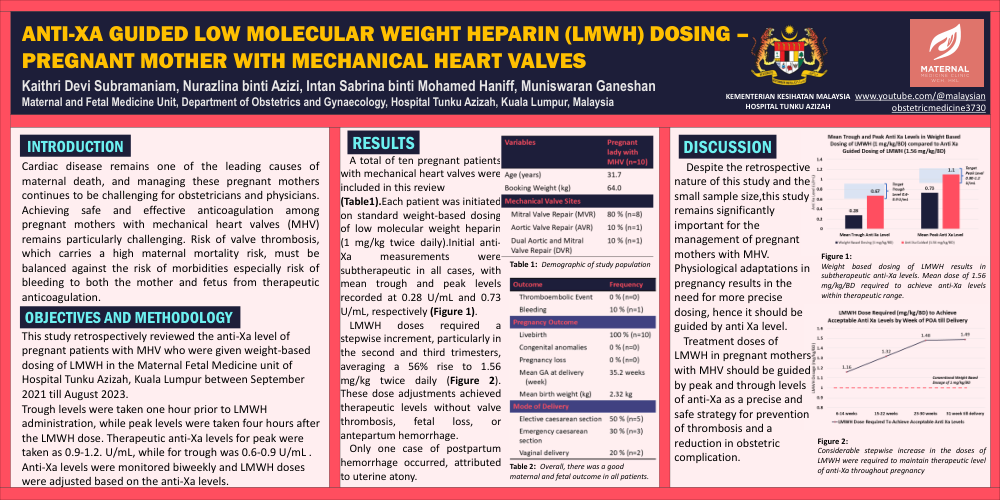
A total of ten pregnant patients with mechanical heart valves were included in this review .Each patient was initiated on standard weight-based dosing of low molecular weight heparin (1 mg/kg twice daily).Initial anti-Xa measurements were subtherapeutic in all cases, with mean trough and peak levels recorded at 0.28 U/mL and 0.73 U/mL, respectively.
LMWH doses required a stepwise increment, particularly in the second and third trimesters, averaging a 56% rise to 1.56 mg/kg twice daily. These dose adjustments achieved therapeutic levels without valve thrombosis, fetal loss, or antepartum hemorrhage. Only one case of postpartum hemorrhage occurred, attributed to uterine atony.
DISCUSSION
Despite the retrospective nature of this study and the small sample size,this study remains significantly important for the management of pregnant mothers with MHV. Physiological adaptations in pregnancy results in the need for more precise dosing, hence it should be guided by anti Xa level. Treatment doses of LMWH in pregnant mothers with MHV should be guided by peak and through levels of anti-Xa as a precise and safe strategy for prevention of thrombosis and a reduction in obstetric complication.