2,281 posters, 63 videos, 56 audios, 43 topics, 18 sessions, 6,174 authors, 2,323 institutions
ePostersLive by SciGen Technologies S.A. All rights reserved.
RCOG World Congress 2025
June 23 - 25, 2025 | ExCeL London, UK
EP.1540
POST PARTUM HAEMORRHAGE: PREVALENCE AND CLINICAL OUTCOMES NAUTH, NNEWI, NIGERIA
Part of Topic
Maternal medicine
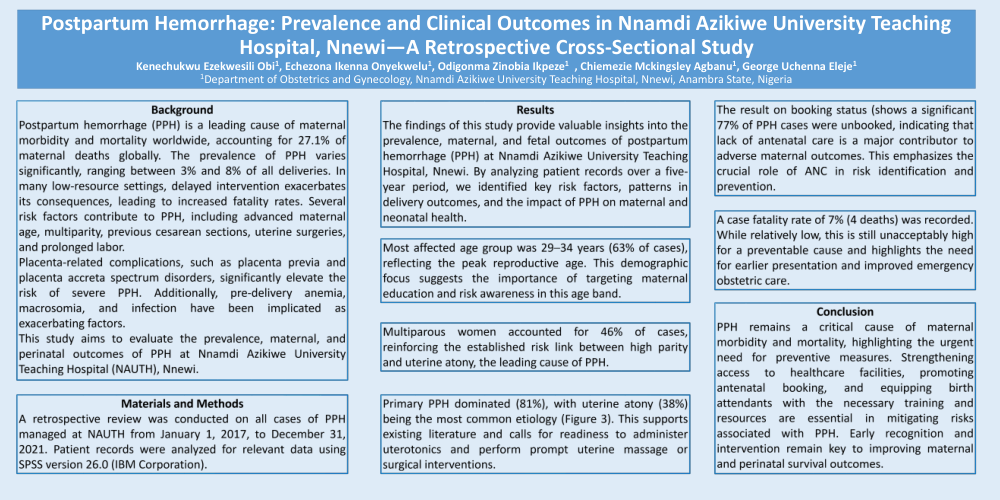
Postpartum Hemorrhage: Prevalence and Clinical Outcomes in Nnamdi Azikiwe University Teaching Hospital, Nnewi—A Retrospective Cross-Sectional Study
Background
Postpartum hemorrhage (PPH) is a leading cause of maternal morbidity and mortality worldwide, accounting for 27.1% of maternal deaths globally. The prevalence of PPH varies significantly, ranging between 3% and 8% of all deliveries. In many low-resource settings, delayed intervention exacerbates its consequences, leading to increased fatality rates. Several risk factors contribute to PPH, including advanced maternal age, multiparity, previous cesarean sections, uterine surgeries, and prolonged labor.
Placenta-related complications, such as placenta previa and placenta accreta spectrum disorders, significantly elevate the risk of severe PPH. Additionally, pre-delivery anemia, macrosomia, and infection have been implicated as exacerbating factors.
This study aims to evaluate the prevalence, maternal, and perinatal outcomes of PPH at Nnamdi Azikiwe University Teaching Hospital (NAUTH), Nnewi.
Materials and Methods
A retrospective review was conducted on all cases of PPH managed at NAUTH from January 1, 2017, to December 31, 2021. Patient records were analyzed for relevant data using SPSS version 26.0 (IBM Corporation).
Results
The findings of this study provide valuable insights into the prevalence, maternal, and fetal outcomes of postpartum hemorrhage (PPH) at Nnamdi Azikiwe University Teaching Hospital, Nnewi. By analyzing patient records over a five-year period, we identified key risk factors, patterns in delivery outcomes, and the impact of PPH on maternal and neonatal health.
Most affected age group was 29–34 years (63% of cases), reflecting the peak reproductive age. This demographic focus suggests the importance of targeting maternal education and risk awareness in this age band.
Multiparous women accounted for 46% of cases, reinforcing the established risk link between high parity and uterine atony, the leading cause of PPH.
Primary PPH dominated (81%), with uterine atony (38%) being the most common etiology (Figure 3). This supports existing literature and calls for readiness to administer uterotonics and perform prompt uterine massage or surgical interventions.
The result on booking status (shows a significant 77% of PPH cases were unbooked, indicating that lack of antenatal care is a major contributor to adverse maternal outcomes. This emphasizes the crucial role of ANC in risk identification and prevention.
A case fatality rate of 7% (4 deaths) was recorded. While relatively low, this is still unacceptably high for a preventable cause and highlights the need for earlier presentation and improved emergency obstetric care.
PPH remains a critical cause of maternal morbidity and mortality, highlighting the urgent need for preventive measures. Strengthening access to healthcare facilities, promoting antenatal booking, and equipping birth attendants with the necessary training and resources are essential in mitigating risks associated with PPH. Early recognition and intervention remain key to improving maternal and perinatal survival outcomes.