2,281 posters, 63 videos, 56 audios, 43 topics, 18 sessions, 6,174 authors, 2,323 institutions
ePostersLive by SciGen Technologies S.A. All rights reserved.
RCOG World Congress 2025
June 23 - 25, 2025 | ExCeL London, UK
EP.1536
Effects of Companionship During Labour on Women’s Experiences of Respectful Maternity Care
Part of Topic
Maternal medicine
Effects of Companionship During Labour on Women’s Experiences of Respectful Maternity Care
ABSTRACT
Objective: This study assessed the prevalence of spouse companionship, and provided insights into women’s desire, and health care providers’ attitudes towards spouse companionship and respectful maternal care in labour. The assumption tested was the null hypothesis (Ho) to assess if companionship in labour does not affect the rate at which women experience respectful maternal health care during labour and positive childbirth experience delivery.
Design: A descriptive cross-sectional study using mixed methods (Quantitative and Qualitative Methods).
Methodology: This study was conducted among women and their healthcare providers at three hospitals in Benin City, Nigeria. In the Quantitative method, 346 women who met the inclusion criteria were interviewed using an interviewer-administered questionnaire. The qualitative method involved focus group discussions with selected nurses and midwives. The Quantitative data were analysed using SPSS 25.0, chi-square analysis was done, Logistic regression was done and P-values of less than 0.05 were considered statistically significant. Qualitative data were analysed using themes analytic tools for qualitative analysis.
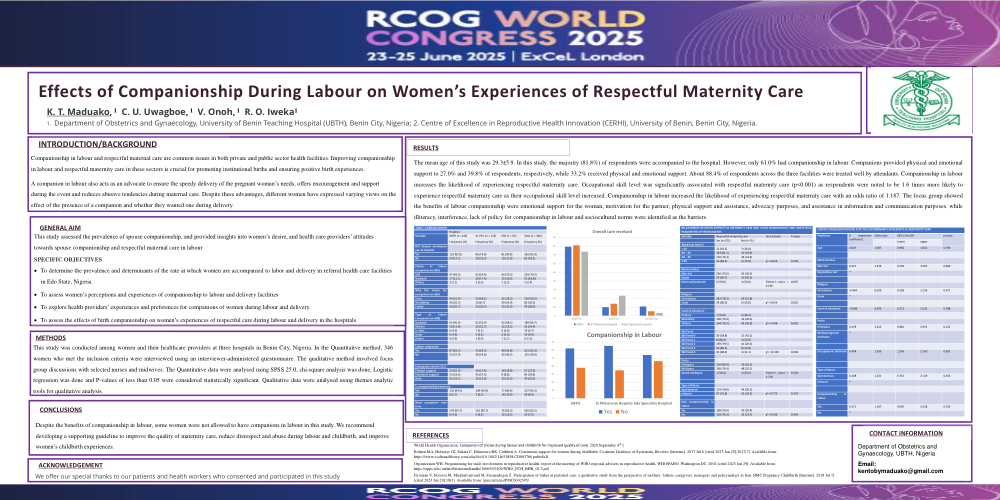
Result: The mean age of this study was 29.3±5.9. In this study, the majority (81.8%) of respondents were accompanied to the hospital. However, only 61.0% had companionship in labour. Companions provided physical and emotional support to 27.0% and 39.8% of respondents respectively while 33.2% received physical and emotional support. About 88.4% of respondents across the three facilities were treated well by attendants. Companionship in labour increases the likelihood of experiencing respectful maternity care. Occupational skill level was significantly associated with respectful maternity care (p<0.001) as respondents were noted to be 1.6 times more likely to experience respectful maternity care as their occupational skill level increased. Companionship in labour increased the likelihood of experiencing respectful maternity care with an odds ratio of 1.187. The focused group showed the benefits of labour companionship were emotional support for the woman, motivation for the partner, physical support and assistance, advocacy purposes, and assistance in information and communication purposes. while illiteracy, interference, lack of policy for companionship in labour and sociocultural norms were identified as the barriers.
Conclusion: Despite the benefits of companionship in labour, some women were not allowed to have companions in labour in this study. We recommend developing a supporting guideline to improve the quality of maternity care, reduce disrespect and abuse during labour and childbirth, and improve women’s childbirth experiences.