2,281 posters, 63 videos, 56 audios, 43 topics, 18 sessions, 6,174 authors, 2,323 institutions
ePostersLive by SciGen Technologies S.A. All rights reserved.
RCOG World Congress 2025
June 23 - 25, 2025 | ExCeL London, UK
EP.1535
Does body mass index affect blood parameters during pregnancy?
Poster Presenter
Authors
Affiliations
Part of Topic
Maternal medicine
Does Body Mass Index affect Blood Parameters during Pregnancy ?
Dr James Pasint-Magyar (FY1), Mrs Anurag Pinto (Consultant Obstetrician and Gynaecologist – Aneurin Bevan University Health board)
Introduction
Pregnancy is characterised by a host of biochemical and haematological changes. During pregnancy, the total blood volume increases by 1.5 litres. Plasma volume rises to meet pregnancy demands however the red cell mass does not increase to the same degree leading to a relative drop in haemoglobin (Hb), termed a dilutional anaemia. (1) Pregnancy is also associated with leucocytosis, and this leads to an increase in the white blood cell count (WBC). WBCs and C-reactive protein (CRP) are used throughout pregnancy as markers for infection and inflammation. (1,2) Currently underlying infection accounts for roughly 50% of maternal deaths globally, (3) which demonstrates the importance of being able to identify abnormal results.
Many factors can affect the biochemical parameters and outcomes during pregnancy. (4) Obesity is linked with chronic inflammation and promotes the release of inflammatory cytokines. (5) Obesity is associated with adverse events during pregnancy such as hypertensive disorders, gestational diabetes, and labour complications. (4) WBC, CRP, ferritin and cytokines have been shown to be raised in obesity, yet it is unclear how body mass index (BMI) may alter these results during pregnancy. (5) It is also controversial whether BMI increases, decreases or has no affect on risk of anaemia as data varies across studies. (6)
As a higher BMI is associated with worsened pregnancy outcomes and may have the potential to alter pregnancy parameters it is therefore important to establish how WBC, Hb and CRP values may be affected by BMI and to establish normal ranges to better optimise treatment and antimicrobial use for pregnant patients. The Hypothesis was that the normal ranges of WBC, Hb and CRP will be affected by BMI.
Aims
To determine the normal ranges of WBC, Hb and CRP during pregnancy and the intrapartum period in the current pregnant population and see if BMI affects this range.
Methods
This was a retrospective study of 400 pregnancies in the Aneurin Bevan University Health board
Estimated delivery date between 2022-2023 and with a BMI of either 20-25 or 45+
FBCs were checked at booking, 28 weeks, pre-labour, during labour and 24 and 48 hours post partum – where available
Mean values of all WBC and Hb recordings were taken at the different timepoints and compared between the two different BMI groups. Data was analysed using T-tests (P<0.05 deemed significant). A sub analysis was undertaken which compared the CRP recordings in those who had emergency and elective caesarean sections and whether BMI had an effect.
Reference ranges for the study population were determined for the WBC and Hb.
Results
The study population (n=400) was drawn from BMI categories of 20-25 (n=300) and 45+ (n=100).
White blood cells
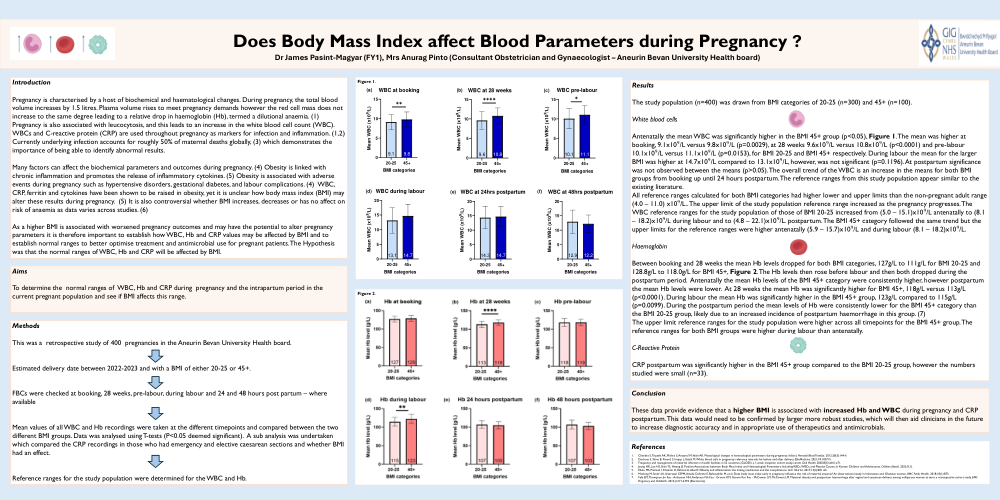
Antenatally the mean WBC was significantly higher in the BMI 45+ group (p<0.05), Figure 1. The mean was higher at booking, 9.1x10⁹/L versus 9.8x10⁹/L (p=0.0029), at 28 weeks 9.6x10⁹/L versus 10.8x10⁹/L (p<0.0001) and pre-labour 10.1x10⁹/L versus 11.1x10⁹/L (p=0.0153), for BMI 20-25 and BMI 45+ respectively. During labour the mean for the larger BMI was higher at 14.7x10⁹/L compared to 13.1x10⁹/L, however, was not significant (p=0.1196). At postpartum significance was not observed between the means (p>0.05). The overall trend of the WBC is an increase in the means for both BMI groups from booking up until 24 hours postpartum. The reference ranges from this study population appear similar to the existing literature. All reference ranges calculated for both BMI categories had higher lower and upper limits than the non-pregnant adult range (4.0 – 11.0) x10⁹/L.. The upper limit of the study population reference range increased as the pregnancy progresses. The WBC reference ranges for the study population of those of BMI 20-25 increased from (5.0 – 15.1)x10⁹/L antenatally to (8.1 – 18.2)x10⁹/L during labour and to (4.8 – 22.1)x10⁹/L. postpartum. The BMI 45+ category followed the same trend but the upper limits for the reference ranges were higher antenatally (5.9 – 15.7)x10⁹/L and during labour (8.1 – 18.2)x10⁹/L.
Haemoglobin
Between booking and 28 weeks the mean Hb levels dropped for both BMI categories, 127g/L to 111g/L for BMI 20-25 and 128.8g/L to 118.0g/L for BMI 45+, Figure 2. The Hb levels then rose before labour and then both dropped during the postpartum period. Antenatally the mean Hb levels of the BMI 45+ category were consistently higher, however postpartum the mean Hb levels were lower. At 28 weeks the mean Hb was significantly higher for BMI 45+, 118g/L versus 113g/L (p<0.0001). During labour the mean Hb was significantly higher in the BMI 45+ group, 123g/L compared to 115g/L (p=0.0099). During the postpartum period the mean levels of Hb were consistently lower for the BMI 45+ category than the BMI 20-25 group, likely due to an increased incidence of postpartum haemorrhage in this group. (7) The upper limit reference ranges for the study population were higher across all timepoints for the BMI 45+ group. The reference ranges for both BMI groups were higher during labour than antenatally.
C-Reactive Protein
CRP postpartum was significantly higher in the BMI 45+ group compared to the BMI 20-25 group, however the numbers studied were small (n=33).
Conclusion
These data provide evidence that a higher BMI is associated with increased Hb and WBC during pregnancy and CRP postpartum. This data would need to be confirmed by larger more robust studies, which will then aid clinicians in the future to increase diagnostic accuracy and in appropriate use of therapeutics and antimicrobials.
References