2,281 posters, 63 videos, 56 audios, 43 topics, 18 sessions, 6,174 authors, 2,323 institutions
ePostersLive by SciGen Technologies S.A. All rights reserved.
RCOG World Congress 2025
June 23 - 25, 2025 | ExCeL London, UK
EP.1527
COMPARING RANDOM URINE PROTEIN-CREATININE RATIO WITH 24 HOUR URINE PROTEIN IN PREECLAMPSIA
Poster Presenter
Authors
Nosheela Javed, Sidra Rauf, Mussarat Batool, Shirza Sharafat
Affiliations
Part of Topic
Maternal medicine
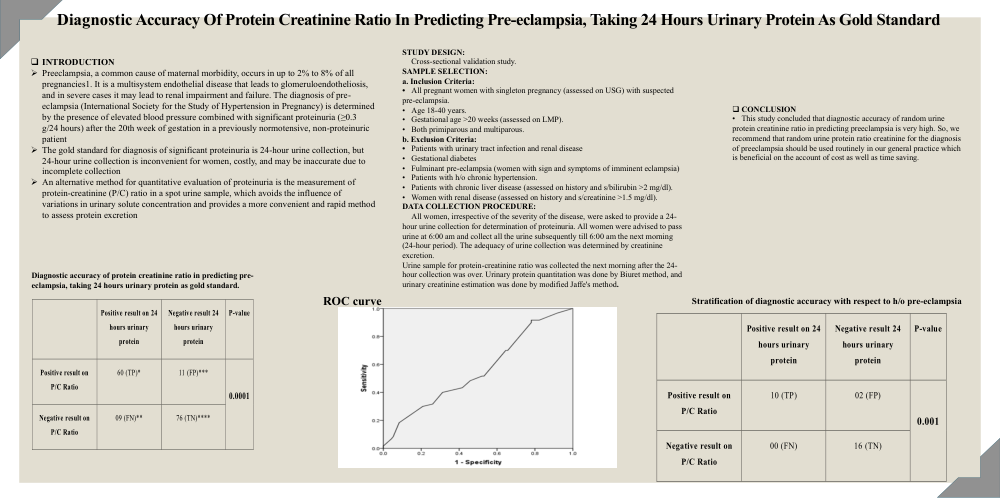
Diagnostic Accuracy Of Protein Creatinine Ratio In Predicting Pre-eclampsia, Taking 24 Hours Urinary Protein As Gold Standard
STUDY DESIGN:
Cross-sectional validation study.
SAMPLE SELECTION:
a. Inclusion Criteria:
• All pregnant women with singleton pregnancy (assessed on USG) with suspected pre-eclampsia.
• Age 18-40 years.
• Gestational age >20 weeks (assessed on LMP).
• Both primiparous and multiparous.
b. Exclusion Criteria:
• Patients with urinary tract infection and renal disease
• Gestational diabetes
• Fulminant pre-eclampsia (women with sign and symptoms of imminent eclampsia)
• Patients with h/o chronic hypertension.
• Patients with chronic liver disease (assessed on history and s/bilirubin >2 mg/dl).
• Women with renal disease (assessed on history and s/creatinine >1.5 mg/dl).
DATA COLLECTION PROCEDURE:
All women, irrespective of the severity of the disease, were asked to provide a 24-hour urine collection for determination of proteinuria. All women were advised to pass urine at 6:00 am and collect all the urine subsequently till 6:00 am the next morning (24-hour period). The adequacy of urine collection was determined by creatinine excretion.
Urine sample for protein-creatinine ratio was collected the next morning after the 24-hour collection was over. Urinary protein quantitation was done by Biuret method, and urinary creatinine estimation was done by modified Jaffe's method.
RESULTS:
Overall sensitivity, specificity, positive predictive value, negative predictive value and diagnostic accuracy of protein creatinine ratio in predicting pre-eclampsia, taking 24 hours urinary protein as gold standard was 86.96%, 87.36%, 84.51%, 89.41% and 87.18% respectively
• This study concluded that diagnostic accuracy of random urine protein creatinine ratio in predicting preeclampsia is very high. So, we recommend that random urine protein ratio creatinine for the diagnosis of preeclampsia should be used routinely in our general practice which is beneficial on the account of cost as well as time saving.