2,281 posters, 63 videos, 56 audios, 43 topics, 18 sessions, 6,174 authors, 2,323 institutions
ePostersLive by SciGen Technologies S.A. All rights reserved.
RCOG World Congress 2025
June 23 - 25, 2025 | ExCeL London, UK
EP.1525
Aspirin delays delivery in pregnancies with placental dysfunction
Poster Presenter
Authors
Ioannis Papastefanou, Esther Wai Chi Tang, Yunyu Chen, Long Nguyen-Hoang, Duy-Anh Nguyen, Linh Thuy Dinh, Ritsuko K. Pooh, Arihiro Shiozaki, Mingming Zheng, Yali Hu, Yunping Wu, Aditya Kusuma, Piengbulan Yapan, Mahesh A Choolani, Mayumi Kaneko, Suchaya Luewan, Tung-Yao Chang, Noppadol Chaiyasit, Tongta Nanthakomon, Yanmin Jiang, Steven W. Shaw, Wing Cheong Leung, Ainaa Syazana Mohamad, Angela Aguilar, So Ling Lau, Nikki M. W. Lee, Daljit S. Sahota, Marc K.C. Chong, Liona C. Poon
Affiliations
Harapan Kita National Women and Children Hospital, Yong Loo Lin School of Medicine, National University of Singapore, Department of Women and Children’s Health, School of Life Course and Population Sciences, Faculty of Life Sciences & Medicine, King’s College London, Department of Obstetrics and Gynaecology, Prince of Wales Hospital, The Chinese University of Hong Kong, Hanoi Obstetrics and Gynecology Hospital, CRIFM Prenatal Medical Clinic, Toyama University Hospital, Nanjing Drum Tower Hospital affiliated to Nanjing University Medical School, Kunming Angel Women and Children's Hospital, the Teaching Hospital of Kunming University of Science and Technology, Faculty of Medicine, Siriraj Hospital, Showa University Hospital, Department of Obstetrics and Gynecology, Faculty of Medicine, Chiang Mai University, Department of Fetal Medicine, Taiji Clinic, King Chulalongkorn Memorial Hospital, Department of Obstetrics and Gynecology, Faculty of Medicine, Thammasat University, Department of Obstetrics, Guangzhou Women and Children's Medical Center, Guangzhou Medical University, Taipei Chang Gung Memorial Hospital, Department of Obstetrics and Gynecology, Kwong Wah Hospital, Department of Obstetrics and Gynecology, Faculty of Medicine, Universiti Kebangsaan Malaysia, University of the Philippines College of Medicine, The Philippine General Hospital, The Jockey Club School of Public Health and Primary Care, Faculty of Medicine, The Chinese University of Hong Kong
Part of Topic
Maternal medicine
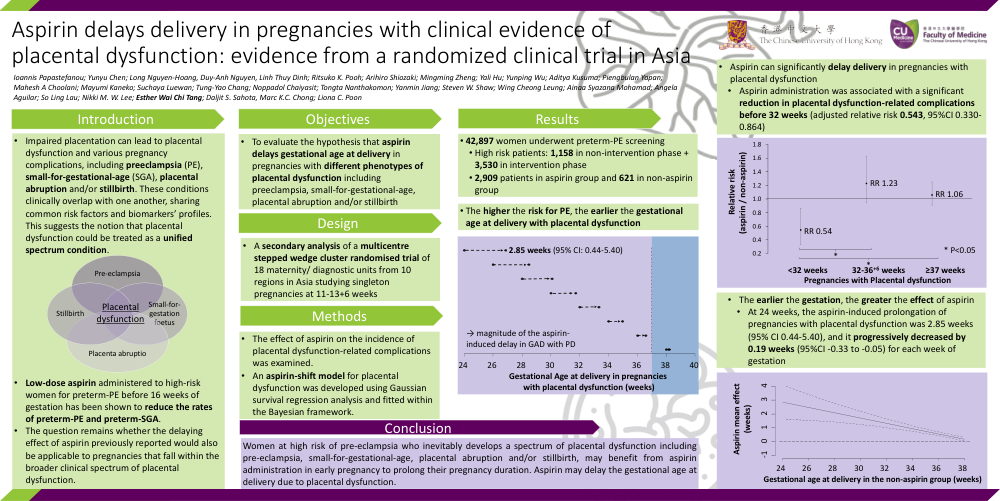
Introduction: Impaired placentation can lead to placental dysfunction and various pregnancy complications, including preeclampsia (PE), small-for-gestational-age (SGA), placental abruption and/or stillbirth. These conditions clinically overlap with one another, sharing common risk factors and biomarkers’ profiles. This suggests the notion that placental dysfunction could be treated as a unified spectrum condition. Low-dose aspirin administered to high-risk women for preterm-PE before 16 weeks of gestation has been shown to reduce the rates of preterm-PE and preterm-SGA. The question remains whether the delaying effect of aspirin previously reported would also be applicable to pregnancies that fall within the broader clinical spectrum of placental dysfunction.
Objectives: To evaluate the hypothesis that aspirin delays gestational age at delivery in pregnancies with different phenotypes of placental dysfunction including preeclampsia, small-for-gestational-age, placental abruption and/or stillbirth.
Design: A secondary analysis of a multicentre stepped wedge cluster randomised trial of 18 maternity/ diagnostic units from 10 regions in Asia studying singleton pregnancies at 11-13+6 weeks.
Methods: The effect of aspirin on the incidence of placental dysfunction-related complications was examined. An aspirin-shift model for placental dysfunction was developed using Gaussian survival regression analysis and fitted within the Bayesian framework.
Results:
- 42,897 women underwent preterm-PE screening
- High risk patients: 1,158 in non-intervention phase + 3,530 in intervention phase; and 2,909 patients in aspirin group and 621 in non-aspirin group