2,281 posters, 63 videos, 56 audios, 43 topics, 18 sessions, 6,174 authors, 2,323 institutions
ePostersLive by SciGen Technologies S.A. All rights reserved.
RCOG World Congress 2025
June 23 - 25, 2025 | ExCeL London, UK
EP.1521
Pressured Decision-Making During Childbirth Increases the Risk of a Distressing Patient Experience
Poster Presenter
Authors
Affiliations
Part of Topic
Maternal medicine
Pressured Decision-Making During Childbirth Increases the Risk of a Distressing Patient Experience
Background.
A woman’s perception of her childbirth experience plays a critical role in shaping her emotional well-being and her transition into motherhood. Negative birth experiences have been linked to postpartum distress, strained maternal-infant bonding, and reduced satisfaction with care. Understanding the factors that contribute to a distressing birth experience is essential for developing targeted interventions to support women's mental health and improve the quality of maternity care.
Objective.
Understand how a negative perception of the labor and delivery experience is influenced by supportive medical care, provider pressure, and patient autonomy and respect.
Methods.
This cross-sectional study was conducted in North Carolina, United States, to identify predictors of labeling childbirth as a distressing experience. An electronic questionnaire was distributed to women who had given birth within the previous two years using an opportunity sampling approach. Respondents rated the statement, “I found giving birth a distressing experience” and answered questions regarding prenatal care, provider pressure for medical intervention, and being involved and respected during their labor and delivery.
Descriptive statistics and logistic regression were used to determine the prevalence of a distressing birth experience and examine predictive factors.
Results.
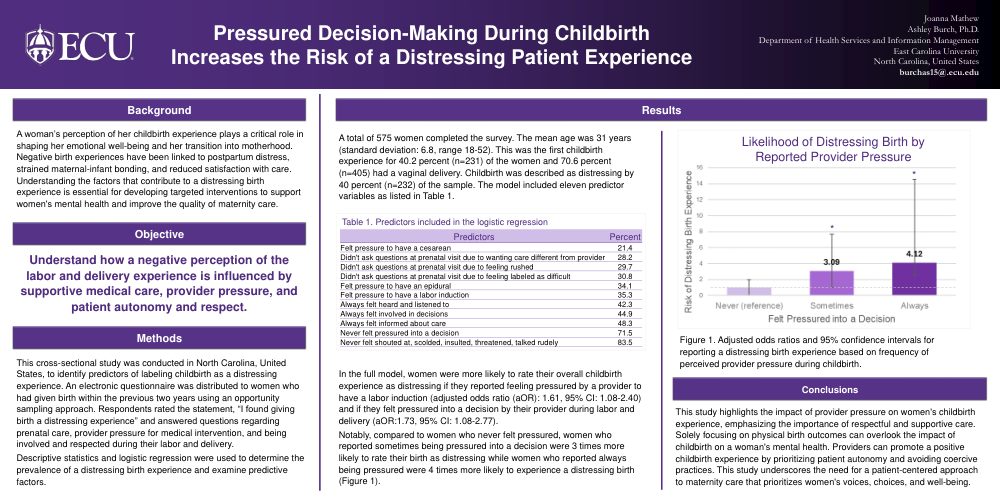
A total of 575 women completed the survey. The mean age was 31 years (standard deviation: 6.8, range 18-52). This was the first childbirth experience for 40.2 percent (n=231) of the women and 70.6 percent (n=405) had a vaginal delivery. Childbirth was described as distressing by 40 percent (n=232) of the sample. The model included eleven predictor variables as listed in Table 1.
In the full model, women were more likely to rate their overall childbirth experience as distressing if they reported feeling pressured by a provider to have a labor induction (adjusted odds ratio (aOR): 1.61, 95% CI: 1.08-2.40) and if they felt pressured into a decision by their provider during labor and delivery (aOR:1.73, 95% CI: 1.08-2.77).
Notably, compared to women who never felt pressured, women who reported sometimes being pressured into a decision were 3 times more likely to rate their birth as distressing while women who reported always being pressured were 4 times more likely to experience a distressing birth (Figure 1).
Conclusions.
This study highlights the impact of provider pressure on women's childbirth experience, emphasizing the importance of respectful and supportive care. Solely focusing on physical birth outcomes can overlook the impact of childbirth on a woman's mental health. Providers can promote a positive childbirth experience by prioritizing patient autonomy and avoiding coercive practices. This study underscores the need for a patient-centered approach to maternity care that prioritizes women's voices, choices, and well-being.