2,281 posters, 63 videos, 56 audios, 43 topics, 18 sessions, 6,174 authors, 2,323 institutions
ePostersLive by SciGen Technologies S.A. All rights reserved.
RCOG World Congress 2025
June 23 - 25, 2025 | ExCeL London, UK
EP.1518
AUDIT ON RECENT GUIDELINES OF WOMEN PRESENTING TO SECONDARY HOSPITAL WITH RFM.
Poster Presenter
Authors
Affiliations
Part of Topic
Maternal medicine
AN AUDIT ON THE RECENT NATIONAL GUIDELINES OF WOMEN PRESENTING TO A SECONDARY CARE HOSPITAL WITH REDUCED FETAL MOVEMENTS.
Mahrukh Mumtaz, Anca Trulea
Dept of Obs & Gynae, Mayo University Hospital, Ireland
Introduction
Reduced fetal movements (RFM) refers to any change in maternal perception of fetal movements, including pattern, strength, or frequency. Clinicians should be aware of the outcomes associated with RFM including the increased risk of stillbirth and/or fetal growth restriction (FGR) 123. Women reporting RFM should undergo a comprehensive assessment of fetal wellbeing
Aim
We conducted an audit from May to September 2024 to assess alignment with recent Irish guidelines. We examined the number of women presenting with RFM, their gestational ages, those not eligible for discharge, and the number receiving an ultrasound within 24 hours. We also reviewed those requiring interventions during their visit.
Methods
This was a retrospective data analysis of all women who visited the hospital with RFM. All patient information was anonymized and entered into a Excel and later analysed. The NWHIP National Clinical Practice Guideline for Reduced Fetal Movements (2024) was the standard used.
Results:
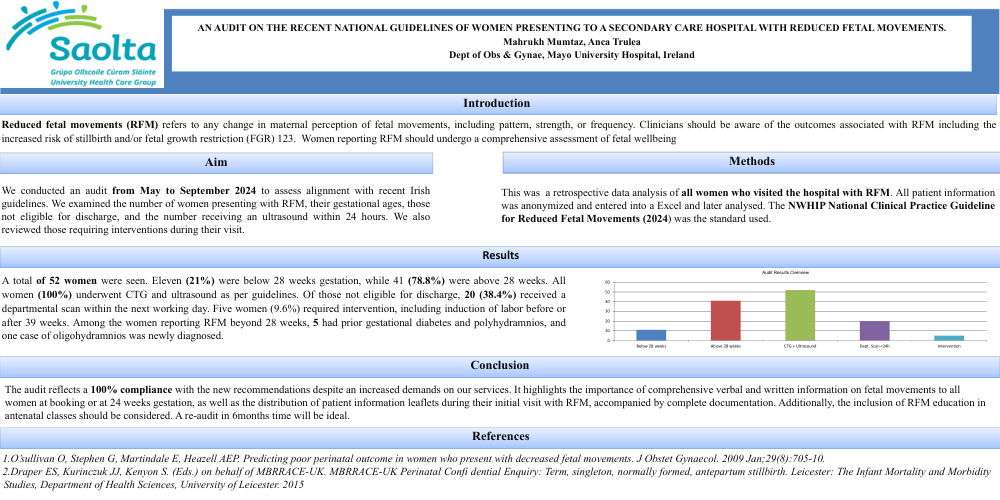
A total of 52 women were seen. Eleven (21%) were below 28 weeks gestation, while 41 (78.8%) were above 28 weeks. All women (100%) underwent CTG and ultrasound as per guidelines. Of those not eligible for discharge, 20 (38.4%) received a departmental scan within the next working day. Five women (9.6%) required intervention, including induction of labor before or after 39 weeks. Among the women reporting RFM beyond 28 weeks, 5 had prior gestational diabetes and polyhydramnios, and one case of oligohydramnios was newly diagnosed
Conclusion
The audit reflects a 100% compliance with the new recommendations despite an increased demands on our services. It highlights the importance of comprehensive verbal and written information on fetal movements to all women at booking or at 24 weeks gestation, as well as the distribution of patient information leaflets during their initial visit with RFM, accompanied by complete documentation. Additionally, the inclusion of RFM education in antenatal classes should be considered. A re-audit in 6months time will be ideal.
References
1.O’sullivan O, Stephen G, Martindale E, Heazell AEP . Predicting poor perinatal outcome in women who present with decreased fetal movements. J Obstet Gynaecol. 2009 Jan;29(8):705-10.
2.Draper ES, Kurinczuk JJ, Kenyon S. (Eds.) on behalf of MBRRACE-UK. MBRRACE-UK Perinatal Confi dential Enquiry: Term, singleton, normally formed, antepartum stillbirth. Leicester: The Infant Mortality and Morbidity
Studies, Department of Health Sciences, University of Leicester . 2015