2,281 posters, 63 videos, 56 audios, 43 topics, 18 sessions, 6,174 authors, 2,323 institutions
ePostersLive by SciGen Technologies S.A. All rights reserved.
RCOG World Congress 2025
June 23 - 25, 2025 | ExCeL London, UK
EP.1517
Postnatal Venous Thromboembolism (VTE) Risk Assessment and appropriate thromboprophylaxis: A cross-site audit
Poster Presenter
Authors
Affiliations
Part of Topic
Maternal medicine
Re-Audit of Postnatal Venous Thromboembolism (VTE) Risk Assessment and Appropriate Thrombo-prophylaxis in Manchester University NHS Foundation Trust
Objective:
Risk assessment of postnatal women is essential to determine patients’ risk of VTE and ensure that thromboprophylaxis is prescribed according to protocol, which in turn reduces the risk of thromboembolic complications, such as Pulmonary Embolism, Deep Venous Thrombosis, and Cerebrovascular Accidents.
Design:
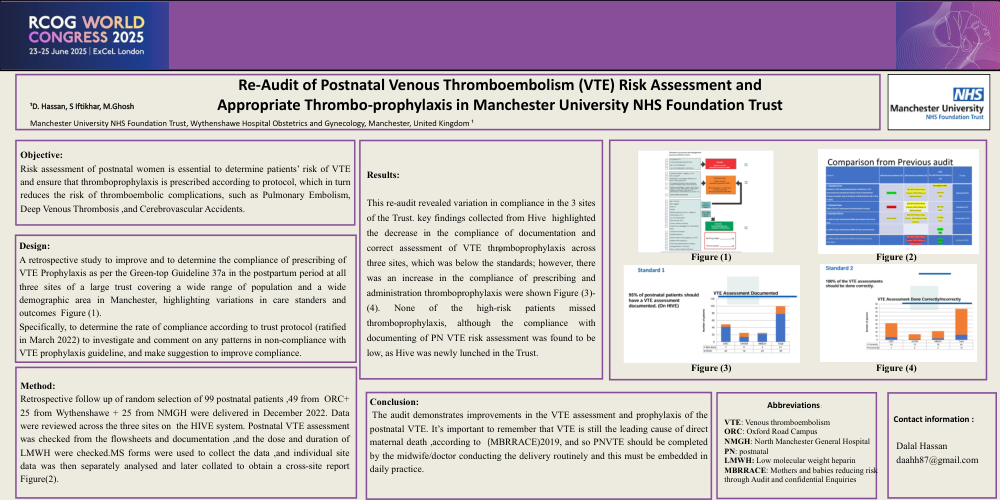
A retrospective study to improve and to determine the compliance of prescribing of VTE Prophylaxis as per the Green-top Guideline 37a in the postpartum period at all three sites of a large trust covering a wide range of population and a wide demographic area in Manchester, highlighting variations in care standards and outcomes.
Specifically, to determine the rate of compliance according to trust protocol (ratified in March 2022), to investigate and comment on any patterns in non-compliance with the VTE prophylaxis guideline, and to make suggestions to improve compliance.
Method:
Retrospective follow-up of a random selection of 99 postnatal patients,49 from ORC+, 25 from Wythenshawe + 25 from NMGH were delivered in December 2022. Data were reviewed across the three sites on the HIVE system. Postnatal VTE assessment was checked from the flowsheets and documentation, and the dose and duration of LMWH were checked.MS forms were used to collect the data, and individual site data were then separately analysed and later collated to obtain a cross-site report.
Results:
This re-audit revealed variation in compliance in the 3 sites of the Trust. Key findings collected from Hive highlighted the decrease in the compliance of documentation and correct assessment of VTE thromboprophylaxis across three sites, which was below the standards; however, there was an increase in the compliance of prescribing and administration of thromboprophylaxis, were shown. None of the high-risk patients missed thromboprophylaxis, although the compliance with documenting PN VTE risk assessment was found to be low, as Hive was newly launched in the Trust.
Conclusion:
The audit demonstrates improvements in the VTE assessment and prophylaxis of the postnatal VTE. It’s important to remember that VTE is still the leading cause of direct maternal death, according to (MBRRACE)2019, and so PNVTE should be completed by the midwife/doctor conducting the delivery routinely, and this must be embedded in daily practice.