1,830 posters, 67 videos, 75 audios, 29 topics, 22 sessions, 4,727 authors, 1,697 institutions
ePostersLive by SciGen Technologies S.A. All rights reserved.
RCOG World Congress 2023
June 12 - 14, 2023 | London, UK

EP.0934
Evaluating the Management and Follow-Up Care of Mid-Trimester Miscarriages
Poster Presenter
Authors
Mohamed Barakat, Hassan Shehata, Sasha Ang, Deena Basha, Radhika Viswanatha
Affiliations
Part of Topic
Early Pregnancy Complications and Gynaecology
Evaluating the Management and Follow-Up Care of Mid-Trimester Miscarriages
Mohamad Barakat, Hassan Shehata, Sasha Ang, Deena Basha, Radhika Viswanatha
Introduction:
-
Mid-trimester miscarriage is defined as the spontaneous loss of pregnancy between 13+0 to 23+6 weeks
-
An estimated 1–2% of second- trimester pregnancies end in a miscarriage before reaching 24 weeks of gestation(1)
-
Risk factors include advancing maternal age, medical co-morbidities, inherited thrombophilic defects, previous miscarriages, genetic and anatomical factors (including cervical weakness and congenital uterine malformation)(1)
Aims:
-
To identify risk factors present within our population
-
Assess the management and follow-up investigations of mid-trimester miscarriages at Epsom and St Helier University Hospitals over a 4-year period
-
To compare this against the proposed guidance stated by the RCOG Greentop Guidelines No.17(1)
-
Provide recommendations to improve our future practice
Methods:
-
All women who underwent a mid- trimester miscarriage between January 2018 and January 2022 at Epsom and St Helier University Hospitals were retrospectively identified
-
Data was collected and analysed on excel regarding risk factors, management and follow-up care provided
-
This was then compared against pre- defined standards as stated by the RCOG guidelines
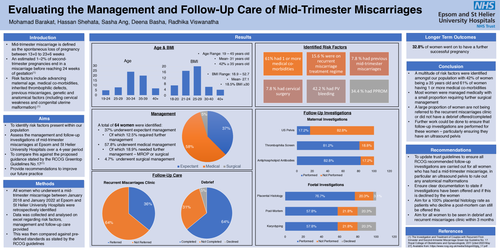
• Age Range: 19 – 45 years old
-
Mean- 31 years old
-
42% ≥ 35 years old
• BMI Range: 18.9 – 52.7 • Mean- 27.1 • 18.5% BMI ≥30
Identified Risk Factors:
61% had 1 or more medical co- morbidities
15.6 % were on recurrent miscarriage treatment regime
7.8 % had previous mid-trimester miscarriages
7.8 % had cervical surgery
42.2 % had PV bleeding
34.4 % had PPROM
Management:
A total of 64 women were identified:
37% underwent expectant management Of which 12.5% required further management
57.8% underwent medical management Of which 18.9% needed further management – MROP or surgical
4.7% underwent surgical management
Follow-Up Care:
Recurrent miscarriages clinic: 36% referred, 64% not referred
Debrief: 64% completed, 31% not completed, 5% declined
Follow-Up Investigations:
Maternal Investigations:
US Pelvis: 17.2% performed, 82.8% not performed
Thrombophilia Screen: 81.2% performed, 18.8% not performed
Antiphospholipid Antibodies: 82.8% performed, 17.2% not performed
Foetal Investigations:
Placental Histology: 76.7% performed, 20.3% not performed, 3.1% declined
Post-Mortem: 57.8% performed, 21.8% not performed, 20.3% declined
Karyotyping: 57.8% performed, 21.8% not performed, 20.3% declined
Longer Term Outcomes:
32.8% of women went on to have a further successful pregnancy
Conclusion:
-
A multitude of risk factors were identified amongst our population with 42% of women being ≥ 35 years old and 61% of women having 1 or more medical co-morbidities
-
Most women were managed medically with a small proportion requiring further surgical management
-
A large proportion of women are not being referred to the recurrent miscarriages clinic or did not have a debrief offered/completed
-
Further work could be done to ensure that follow-up investigations are performed for these women – particularly ensuring they have an ultrasound pelvis
-
To update trust guidelines to ensure all RCOG recommended follow-up investigations are carried out for all women who has had a mid-trimester miscarriage, in particular an ultrasound pelvis to rule out any anatomical malformations
-
Ensure clear documentation to state if investigations have been offered and if this is declined by the women
-
Aim for a 100% placental histology rate as patients who decline a post-mortem can still be offered this
-
Aim for all women to be seen in debrief and recurrent miscarriages clinic within 3 months
References:
(1) The Investigation and Treatment of Couples with Recurrent First- trimester and Second-trimester Miscarriage Green-top Guideline No. 17. Royal College of Obstetricians and Gynaecologists; 2011 [cited 2023 May 27]. Available from: https://www.rcog.org.uk/media/3cbgonl0/gtg_17.pdf