1,830 posters, 67 videos, 75 audios, 29 topics, 22 sessions, 4,727 authors, 1,697 institutions
ePostersLive by SciGen Technologies S.A. All rights reserved.
RCOG World Congress 2023
June 12 - 14, 2023 | London, UK

EP.0116
The feasibility of the M6-Risk-Model for managing PULs in the DGH setting
Poster Presenter
Authors
Vicky Minns, Rhian Gisby, Ivie Okwa, Emma Doherty, Nadia Amokrane, Hassan Shehata, Asli Ucyigit
Affiliations
Part of Topic
Early Pregnancy Complications and Gynaecology
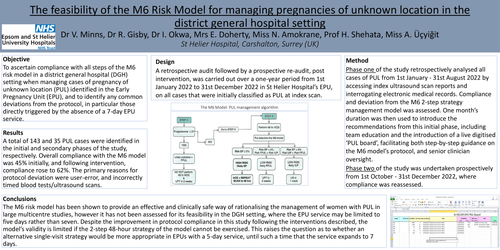
Title: The feasibility of the M6 Risk Model for managing pregnancies of unknown location in the district general hospital setting.
Objective: To ascertain compliance with all steps of the M6 risk model in a district general hospital (DGH) setting when managing cases of pregnancy of unknown location (PUL) identified in the Early Pregnancy Unit (EPU), and to identify any common deviations from the protocol, in particular those directly triggered by the absence of a 7-day EPU service.
Design: A retrospective audit followed by a prospective re-audit, post intervention, was carried out over a one-year period from 1st January 2022 to 31st December 2022 in St Helier Hospital’s EPU, on all cases that were initially classified as PUL at index scan.
Method: Phase one of the study retrospectively analysed all cases of PUL from 1st January - 31st August 2022 by accessing index ultrasound scan reports and interrogating electronic medical records. Compliance and deviation from the M6 2-step strategy management model was assessed. One month’s duration was then used to introduce the recommendations from this initial phase, including team education and the introduction of a live digitised ‘PUL board’, facilitating both step-by-step guidance on the M6 model’s protocol, and senior clinician oversight. Phase two of the study was undertaken prospectively from 1st October - 31st December 2022, where compliance was reassessed.
Results: A total of 143 and 35 PUL cases were identified in the initial and secondary phases of the study, respectively. Overall compliance with the M6 model was 45% initially, and following intervention, compliance rose to 62%. The primary reasons for protocol deviation were user-error, and incorrectly timed blood tests/ultrasound scans.
Conclusions: The M6 risk model has been shown to provide an effective and clinically safe way of rationalising the management of women with PUL in large multicentre studies, however it has not been assessed for its feasibility in the DGH setting, where the EPU service may be limited to five days rather than seven. Despite the improvement in protocol compliance in this study following the interventions described, the model’s validity is limited if the 2-step 48-hour strategy of the model cannot be exercised. This raises the question as to whether an alternative single-visit strategy would be more appropriate in EPUs with a 5-day service, until such a time that the service expands to 7 days.