1,830 posters, 67 videos, 75 audios, 29 topics, 22 sessions, 4,727 authors, 1,697 institutions
ePostersLive by SciGen Technologies S.A. All rights reserved.
RCOG World Congress 2023
June 12 - 14, 2023 | London, UK

EP.0191
Triaging Pregnancy of Unknown Location: Comparison of NICE ratios with M6NP model.
Poster Presenter
Authors
Affiliations
Part of Topic
Early Pregnancy Complications and Gynaecology
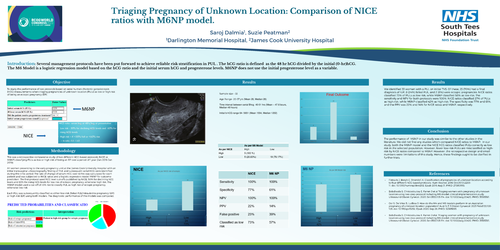
Objective: To study the performance of two protocols based on serial human chorionic gonadotropin (HCG) measurements when triaging pregnancies of unknown location (PULs) as low or high risk of being an ectopic pregnancy (EP).
Design: This was a retrospective comparative study of two different HCG-based protocols (NICE vs M6NP) classifying PULs as low or high risk of being an EP over a period of 1 year.
Method: All women presenting to the early pregnancy unit with an initial transvaginal ultrasonography finding of PUL and subsequent serial HCG were identified. The rate of change of serum HCG over 48 hrs was calculated for each patient and was subjected to NICE ratios and a logistic regression model M6NP for outcome prediction. Each PUL was subsequently classified as either low-risk (failed PUL/Intrauterine pregnancy IUP) or high-risk (EP) using both models. The first protocol used hCG level cut-offs published by NICE, 50% for declining hCG levels and 63% for rising hCG levels for low risk of ectopic pregnancy, otherwise high risk. The M6NP model used a cut-off of ≥5% risk to classify PUL as high risk of ectopic pregnancy, otherwise low risk. The diagnostic performance of the models was compared.
Results: We identified 33 women with a PUL on initial TVS. Of these, 23 (70%) had a final diagnosis of IUP, 8 (24%) failed PUL, and 2 (8%) were ectopic pregnancies. NICE ratios classified 73% of PULs as low risk, while M6NP classified 58% as low risk. The sensitivity and NPV for both protocols were 100%. NICE ratios classified 27% of PULs as high risk, while M6NP classified 42% as high risk. The specificity was 77% and 61%, and the PPV was 22% and 14% for NICE ratios and M6NP, respectively.
Conclusions: In our study, both the M6NP model and the NICE hCG ratios classified PULs correctly as low risk in the selected population. However, fewer low-risk PULs are misclassified as high-risk by NICE ratios compared to M6NP. However, the retrospective design and small numbers were limitations of this study. Hence, these findings ought to be clarified in further trials.