1,830 posters, 67 videos, 75 audios, 29 topics, 22 sessions, 4,727 authors, 1,697 institutions
ePostersLive by SciGen Technologies S.A. All rights reserved.
RCOG World Congress 2023
June 12 - 14, 2023 | London, UK

EP.0052
The epidemiological burden of preterm labour and delivery: A systematic literature review
Poster Presenter
Part of Topic
Early Pregnancy Complications and Gynaecology
The epidemiological burden of preterm labour and delivery: A systematic literature review
Background:
• Preterm birth (PTB) is the leading cause of mortality in children <5 years.1
• The rate of PTB and its variability by important factors like geographic location, gestational age (GA), race/ethnicity, and birth plurality have been documented.1,2
• Preterm labour (PTL), defined as regular uterine contractions with cervical dilation <37 weeks GA,3-5 is a causal factor in nearly 50% of PTB.3
• Avoiding or delaying PTL could be a mechanism in alleviating the burden associated with PTB.6
Objective:
• To synthesize published data from the US and globally on the incidence and prevalence of PTL and PTB.
Methods:
• A systematic literature review of MEDLINE and Embase supplemented with web-based and grey literature searches was conducted to identify nationally representative incidence and prevalence estimates of PTL and PTB in countries selected a priori:
o United States (US), Canada, Italy, France, Spain, Germany, United Kingdom (UK), Australia, Japan, and China.
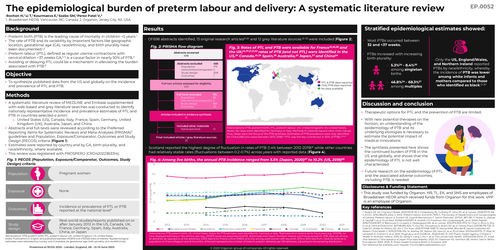
• Abstracts and full-texts were reviewed according to the Preferred Reporting Items for Systematic Reviews and Meta-Analyses (PRISMA)7 guidelines and Population, Exposure/Comparator, Outcomes and Study Design (PECOS) criteria (Figure 1).
• Estimates were reported by country and by GA, birth plurality, and race/ethnicity, where available.
• This review was registered with PROSPERO (CRD42022363314).
Results:
• Of 698 abstracts identified, 13 original research articles8-20 and 12 grey literature sources 21-32 were included (Figure 2).
• Scotland reported the highest degree of fluctuation in rates of PTB (1.4% between 2012-2019)31 while other countries had relatively stable rates (fluctuations between 0.2-0.7%) across years with reported data (Figure 4).
• Stratified epidemiological estimates showed:
o Most PTBs occurred between 32 and <37 weeks.
o PTBs increased with increasing birth plurality: 5.3%24 - 8.4%30 among singleton births; 46.8%24 - 68.3%31 among multiples
o Only the US, England/Wales, and Northern Ireland reported PTBs by race/ethnicity, whereby the incidence of PTB was lower among white infants and mothers compared to those who identified as black.21,30
Discussion and conclusion:
• Therapeutic options for PTL and the prevention of PTB are limited.
• With new potential therapies on the horizon, an understanding of the epidemiology of PTB and its underlying etiologies is necessary to estimate the potential impact of medical innovations.
• The synthesis presented here shows the continued burden of PTB in the US and globally, and shows that the epidemiology of PTL is not well characterized
• Future research on the epidemiology of PTL and the associated adverse outcomes, including PTB, is needed.