1,830 posters, 67 videos, 75 audios, 29 topics, 22 sessions, 4,727 authors, 1,697 institutions
ePostersLive by SciGen Technologies S.A. All rights reserved.
RCOG World Congress 2023
June 12 - 14, 2023 | London, UK

EP.0893
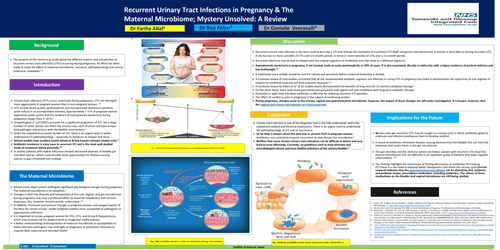
RECURRENT URINARY TRACT INFECTIONS IN PREGNANCY & THE MATERNAL MICROBIOME; A REVIEW.
Poster Presenter
Part of Topic
Urogynaecology/Pelvic Floor
Recurrent Urinary Tract Infections in Pregnancy & The
Maternal Microbiome; Mystery Unsolved: A Review
Conflict of Interest: None
Background
- The purpose of the review is to study about the different aspects and complexities of recurrent urinary tract infections (UTIs) occurring during pregnancy. An effort has been made to study the effect of maternal microbiome, causation, pathophysiology and various treatment modalities.3,1
Introduction
- Urinary tract infections (UTIs) occur commonly during pregnancy. UTIs are managed more aggressively in pregnant women than in non-pregnant women. 2,8
- UTIs include acute cystitis, pyelonephritis and asymptomatic bacteriuria (positive urine culture in an asymptomatic woman). Approximately 1–4 % of pregnant women experience acute cystitis and the incidence of asymptomatic bacteriuria during pregnancy ranges from 2–10 %.2
- Uropathogenic E. coli (UPEC) accounts for a significant proportion of UTI, but a large number of other species can infect the urinary tract, each of which will have unique host-pathogen interactions with the bladder environment. 4
- Given the substantial economic burden of UTI, there is an urgent need to better understand UTI pathophysiology – especially its tendency to relapse and recur.
- Animal models have enabled crucial advances & few human-relevant models exist.3
- Antibiotic resistance is a key issue in recurrent UTI and is the most well-studied mode of treatment failure generally. 5,8
- In studies patients with repeat infections showed decreased diversity of healthy gut microbial species, which could provide more opportunities for disease-causing species to gain a foothold and multiply.
The Maternal Microbiome
- Almost every organ system undergoes significant physiological changes during pregnancy. The maternal microbiome is no exception. 1
- Changes in both the diversity and composition of the oral, vaginal, and gut microbiomes during pregnancy may have a profound effect on maternal metabolism and immune responses; this, however, remains poorly understood. 2,3
- In addition, hormonal and immune changes in pregnant women, and unique tropism of the fetus for certain viruses, render pregnant women more susceptible to pathogenic or opportunistic infections.
- It is important to screen pregnant women for STIs, UTIs, and Group B Streptococcus, which may increase risk for preterm birth or congenital malformations.
- A better understanding of dysregulation of maternal microbiome to susceptibility to these infectious pathogens may shed light on diagnostic or preventive measures to improve both maternal and neonatal health.
Discussion
- Recurrent urinary tract infection is the term used to describe a UTI that follows the resolution of a previous UTI (both symptoms and bacteriuria). A woman is described as having recurrent UTIs if she has two or more episodes of UTIs over a 6-month period, or three or more episodes of UTIs over a 12-month period.
- Recurrent infections may be due to relapse with the original organism or reinfection with the same or a different organism.
- Asymptomatic bacteriuria in pregnancy, if not treated, leads to acute pyelonephritis in 30% of cases. It is also associated, directly or indirectly, with a higher incidence of preterm delivery and low birthweight. 8
- A midstream urine sample should be sent for culture and sensitivity before empirical treatment is started.
- A Cochrane review of nine studies concluded that all the recommended antibiotic regimens are effective in curing UTIs in pregnancy but failed to demonstrate the superiority of one regimen in relation to combined maternal and fetal outcome measures.6.7
- A Cochrane review by Albert et al of 19 studies clearly demonstrated the benefits of long-term (6–12 months) antibiotic therapy. 6
- On the other hand, there were more gastrointestinal symptoms and vaginal and oral candidiasis with long-term antibiotic therapy.
- Postcoital or night-time low-dose antibiotics is effective for reducing recurrent UTI episodes
- The effect of cranberry juice in pregnancy is the subject of continuing studies.
- During pregnancy, changes occur to the urinary, vaginal and gastrointestinal microbiome, however, the impact of these changes are still under investigation. It is known, however, that the vaginal and urinary microbiomes are interconnected.
Conclusion
- Urinary tract infection is one of the diagnoses that is not fully understood, and it has substantial medical and financial implications. There is an urgent need to understand the pathophysiology of UTI and its recurrence.
- So far little is known about the best way to prevent RUTI in pregnant women. Antibiotics may contribute towards recurrence as they disrupt the microbiome.2
- Biofilms that cause chronic urinary tract infections can be difficult to detect and very hard to treat efficiently. Currently, no guidelines exist to help clinicians and microbiologists detect and treat biofilm infections of the urinary bladder.5
Implications for the Future
- Women who get recurrent UTIs may be caught in a vicious cycle in which antibiotics given to eradicate one infection predispose them to develop another.
- A round of antibiotics eliminates disease-causing bacteria from the bladder but not from the intestines and create havoc in the gut microbiome.
- The gut microbes and the immune system are linked, women with recurrent UTIs have less diverse microbiomes that are deficient in an important group of bacteria that helps regulate inflammation. 1,4,5
- The findings highlight the importance of finding alternatives to antibiotics for treating UTI.There is a real need to develop better therapeutics that break this vicious cycle.Current research indicates that the gastrointestinal microbiome can be altered by diet, probiotic and prebiotic intake, prescription medication, including antibiotics. The effects of these medications on the bladder and vaginal microbiome are still being studied.
References
- Kumar, M., Saadaoui, M., & Al Khodor, S. (2022). Infections and Pregnancy: Effects on Maternal and Child Health. Frontiers in Cellular and Infection Microbiology, 12. https://doi.org/10.3389/fcimb.2022.873253 (Fig.1)
- McCormick T, Ashe R.G, Kearney P.M. 2008. Urinary Tract Infection in Pregnancy. The Obstetrician and Gynaecologist. 10:156-162.
- Meštrović, T., Matijašić, M., Perić, M., Čipčić Paljetak, H., Barešić, A., & Verbanac, D. (2020). The Role of Gut, Vaginal, and Urinary Microbiome in Urinary Tract Infections: From Bench to Bedside. Diagnostics (Basel, Switzerland), 11(1), 7. https://doi.org/10.3390/diagnostics11010007
- O'Brien VP, Hannan TJ, Schaeffer AJ, Hultgren SJ. Are you experienced? Understanding bladder innate immunity in the context of recurrent urinary tract infection. Curr Opin Infect Dis. 2015 Feb;28(1) 97-105. doi:10.1097/qco.0000000000000130. PMID: 25517222; PMCID: PMC4365976.(Fig.2)
- Patrick D. Olson, Sheryl S. Justice, David A. Hunstad, Chapter 76 - Escherichia coli in Urinary Tract Infections, Editor(s): Yi-Wei Tang, Max Sussman, Dongyou Liu, Ian Poxton, Joseph Schwartzman,Molecular Medical Microbiology (Second Edition),Academic Press,2015, (Fig.3)
- Villar J, Widmer M, Lydon-Rochelle MT, Glmezoglu AM, Roganti A. Duration of treatment for asymptomatic bacteriuria during pregnancy. Cochrane Database Syst Rev 2000;(2):CD000491.
- Guinto VT, De Guia B, Festin MR, Dowswell T. Different antibiotic regimens for treating asymptomatic bacteriuria in pregnancy. Cochrane Database Syst Rev 2010;(9):CD00785.
- Scottish Intercollegiate Guidelines Network. Management of Suspected Bacterial Urinary Tract Infection in Adult Women. SIGN 160. Edinburgh: SIGN; 2020.