1,830 posters, 67 videos, 75 audios, 29 topics, 22 sessions, 4,727 authors, 1,697 institutions
ePostersLive by SciGen Technologies S.A. All rights reserved.
RCOG World Congress 2023
June 12 - 14, 2023 | London, UK

EP.0274
Audit on medium and short term outcomes of urethral bulking
Poster Presenter
Part of Topic
Urogynaecology/Pelvic Floor
Audit on medium and short term outcomes of urethral bulking
Dr. Shaazma Zainab Naqvi
Dr. Olga Divakova
Dr. Zainab Khan
OBJECTIVES
Urethral Bulking System (Bulkamid®) is a permanently implanted, non-resorbable, injectable hydrogel for urethral bulking and is used as a minimally invasive treatment option for women with stress urinary incontinence (SUI) or stress-predominant mixed urinary incontinence (MUI). The aim of this audit is to assess medium and short-term outcomes of urethral bulking performed under general and local anaesthesia (LA) for the treatment of primary SUI in women.
DESIGN
This was a retrospective audit covering a 3-year-period (2019-2022) at a district general hospital - Epsom and St Helier University Hospitals NHS Trust, UK.
METHOD
Data was collected via Electronic Patient Records, British Society of Urogynaecology (BSUG) portal and hospital paper notes. Patient outcomes were analysed using validated and standardised PGI-I (Patient global impression of improvement for incontinence) questionnaire which was completed at baseline and between 6 months to 3 years period, post procedure, depending on the time of the latest follow-up.
Parameters such as BMI, type of anaesthesia, pain scores (applicable in cases of LA) and desire for alternative surgical options were collated and analysed. 93 women underwent urethral bulking after receiving the options for surgical management of SUI as per the NICE guidelines.
RESULT
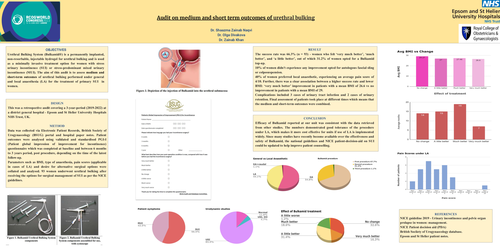
The success rate was 66.3% (n = 93) - women who felt ‘very much better’, ‘much better’, and ‘a little better’, out of which 31.2% of women opted for a Bulkamid top-up.
10% of women didn't experience any improvement opted for autologous fascial sling or colposuspension.
40% of women preferred local anaesthetic, experiencing an average pain score of 4/10. Further, there was a clear association between a higher success rate and lower BMI: ‘very much better’ improvement in patients with a mean BMI of 26.6 vs no improvement in patients with a mean BMI of 29.
Complications included 3 cases of urinary tract infection and 2 cases of urinary retention. Final assessment of patients took place at different times which means that the medium and short-term outcomes were combined.
CONCLUSION
Efficacy of Bulkamid reported at our unit was consistent with the data retrieved from other studies. The numbers demonstrated good tolerance of the procedure under LA, which makes it more cost effective for units if use of LA is implemented widely. Since many studies have recently become available over the effectiveness and safety of Bulkamid, the national guidelines and NICE patient-decision-aid on SUI could be updated to help improve patient counselling.
REFERENCES
NICE guideline 2019 - Urinary incontinence and pelvic organ prolapse in women: management.
NICE Patient decision aid (PDA)
British Sociiety of Urogynaecology database.
Epsom and St Helier patient notes.