1,830 posters, 67 videos, 75 audios, 29 topics, 22 sessions, 4,727 authors, 1,697 institutions
ePostersLive by SciGen Technologies S.A. All rights reserved.
RCOG World Congress 2023
June 12 - 14, 2023 | London, UK

EP.0451
Exploring the safety and efficacy of nurse-led cystoscopy: A systematic review
Poster Presenter
Part of Topic
Urogynaecology/Pelvic Floor
A Systematic Review of Nurse-Led Cystoscopy as a Safe and Effective Alternative to Consultant-Led Services
INTRODUCTION
• The growing awareness of lower urinary tract symptoms (LUTS) among women where
prevalence is estimated at 76% (Coyne et al., 2009), has led to an increased demand for
cystoscopy.
• Unfortunately, this led to longer wait times , particularly in the post-pandemic era.
• To address the mismatch between demand and workforce capacity, nurses trained to
perform cystoscopy under the supervision of urologists (Richardson and Cunliffe, 2003).
• Nurse-led cystoscopy clinics have been established in urology (Gidlow et al., 2000),
although this approach is relatively new in urogynaecology.
OBJECTIVE
To evaluate the safety, efficacy, acceptability, and training requirements for cystoscopy
performed by nurses.
METHODS
• Review protocol: The protocol, established a priori, was registered with the
PROSPERO database (CRD42021270171).
•Literature search: Relevant studies were identified through electronic searches of
databases including PubMed and Embase up to February 4, 2021. Conference
abstracts from international organizations such as the International Continence
Society (ICS) and the International Urogynaecology Association (IUGA) etc.
•Inclusion and exclusion criteria: Studies reporting on nurse-led cystoscopy and the
relevant outcome measures (listed below) in adult patients were included.
•Study selection and data extraction: Two reviewers independently screened titles
and abstracts, and full-text articles were assessed for eligibility. A standardized data
extraction form was used to extract data,.
•Quality assessment: The Critical Appraisal of Skills Programme (CASP) checklist was
used
•Data synthesis: A thematic analysis and narrative synthesis were performed to
analyse and summarise the results.
•Outcome measures: Both quantitative and qualitative outcome measures were
considered: patient acceptability, diagnostic yield, user learning curve, costs, impact
on wait lists, process, training required, implementation issues, user impressions,
acceptability, staff impressions, and service impact.
RESULTS:
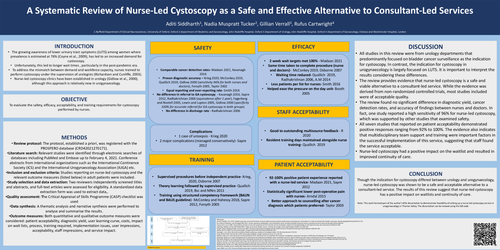
SAFETY:
• Comparable cancer detection rates- Madaan 2021, Kavanagh
2016
• Proven diagnostic accuracy – Krieg 2020, McConkey 2019,
Quallich 2019, Gidlow 2000 (sensitivity 96% for both nurses and
doctors), Forsyth 2005, Taylor 2002
• Equal reporting and over-reporting rate- Smith 2016
• No difference in referral to GA cystoscopy - Kavanagh 2016, Sapre
2012, Radhakrishnan 2006 (equivalence after 1 year), Fagerberg
and Nostell 2005, Lewin and Lupton 2005, Gidlow 2000 (specificity
100% for accurate referral for GA cystoscopy in both groups)
• No difference in discharge rate - Radhakrishnan 2006
Complications
• 1 case of urosepsis - Krieg 2020
• 2 major complications (managed conservatively)- Sapre
2012
EFFICACY:
2 week wait targets met 100% - Madaan 2021
• Same time taken to complete procedure (nurse
and doctors)- McConkey 2019, Osborne 2007
• Waiting time reduced- Quallich 2019,
Radhakrishnan 2006, A.M 2014
• Less patients per list for nurses- Smith 2016
• Helped ease the pressure on the day unit- Booth
2005
STAFF ACCEPTABILITY:
Good to outstanding multisource feedback - R
2020
• Resident training days maintained alongside nurse
training- Quallich 2019
TRAINING:
Supervised procedures before independent practice- Krieg,
2020, Osborne 2007
• Theory learning followed by supervised practice- Quallich
2019, Bsc and MNrs 2011
• Training using structured competency framework (BAUN
and BAUS guideline)- McConkey and Hahessy 2018, Sapre
2012, Forsyth 2005
PATIENT ACCEPTBILITY:
92-100% positive patient experience reported
with a nurse-led service- Madaan 2021, Sapre
2012
• Statistically significant lower post-operative pain
with nurses- Arndal 2015
• Better approach to counselling after cancer
diagnosis which patients preferred- Taylor 2003
DISCUSSION:
DISCUSSION
• All studies in this review were from urology departments that
predominantly focused on bladder cancer surveillance as the indication
for cystoscopy. In contrast, the indication for cystoscopy in
urogynaecology is largely focused on LUTS. It is important to interpret the
results considering these differences.
• The review provides evidence that nurse-led cystoscopy is a safe and
viable alternative to a consultant-led service. While the evidence was
derived from non-randomized controlled trials, most studies included
were of acceptable quality.
• The review found no significant difference in diagnostic yield, cancer
detection rates, and accuracy of findings between nurses and doctors. In
fact, one study reported a high sensitivity of 96% for nurse-led cystoscopy,
which was supported by other studies that examined safety.
• All seven studies that reported on patient acceptability demonstrated
positive responses ranging from 92% to 100%. The evidence also indicates
that multidisciplinary team support and training were important factors in
the successful implementation of this service, suggesting that staff found
the service acceptable.
• Nurse-led cystoscopy had a positive impact on the waitlist and resulted in
improved continuity of care.
CONCLUSION:
CONCLUSION
Though the indication for cystoscopy differed between urology and urogynaecology,
nurse-led cystoscopy was shown to be a safe and acceptable alternative to a
consultant-led service. The results of this review suggest that nurse-led cystoscopy
has a positive impact on waitlists and continuity of care.
Note: This work formed part of the author's MSc dissertation to demonstrate feasibility of setting up a nurse led cystoscopy service in
urogynaecology in Thames Valley.
REFERENCES:
Arndal, Elisabeth, et al. 2015. Flexible cystoscopy can be performed by nurses-An eight day post procedure questionnaire measuring pain and symptoms, in male out-patients after flexible cystoscopy. Nordisk sygeplejeforskning 5(04):411-421.
Bsc, Kathryn Chatterton, and Pat Bugeja MNrs 2011. Nurses' experience establishing a nurse-led bladder cancer surveillance flexible cystoscopy service. Australian Journal of Advanced Nursing (Online) 28(4):53.
Coyne, Karin S, et al. 2009. The prevalence of lower urinary tract symptoms (LUTS) in the USA, the UK and Sweden: results from the Epidemiology of LUTS (EpiLUTS) study. BJU international 104(3):352-360.
Fagerberg, Matilda, and Per-Olof Nostell 2005. Follow up of urinary bladder cancer--a task for the urology nurse? Lakartidningen 102(30-31):2149-2150.
Forsyth, Isobel, Shafaque Shaikh, and Iain Gunn 2005. The Nurse Cystoscopist Extending the Role. British Journal of Perioperative Nursing (United Kingdom) 15(8):342-345.
Gidlow, AB et al. 2000. The nurse cystoscopist: a feasible option? BJU international 85(6):651-654.
Kavanagh, L, et al. 2016. Nurse-led surveillance flexible cystoscopy: evidence of oncological safety: 176. BJU International 117:92-93.
Krieg, Christy B 2020. The journey to office cystoscopy privileging. Urologic nursing vol. 40 (no. 2); p. 99-103.
Madaan, Anika, et al. 2021. Nurse-led one stop haematuria clinic: Outcomes from 2,714 patients. BJUI Compass. management, Association of project. In APM body of knowledge, Vol. 7th edition.
McConkey, Robert, et al. 2019. Development of an advanced nurse practitioner led bladder cancer surveillance service in Ireland: Preliminary audit results. International Journal of Urological Nursing 13(3):114-114.
McConkey, Robert W, and Sinead Hahessy 2018. Developing the advanced nursing practice role in non-muscle invasive bladder cancer surveillance in Ireland. International Journal of Urological Nursing 12(2-3):91-95.
Osborne, Sue 2007. Nurse-led flexible cystoscopy: the UK experience informs a New Zealand nurse specialist’s training. International Journal of Urological Nursing 1(2):58-63.
Quallich, Susanne, et al. 2019. An innovative nurse-led cystoscopy clinic in Denmark. International Journal of Urological Nursing 13(1):39-43.
Radhakrishnan, Suresh, et al. 2006. Nurse-led flexible cystoscopy: experience from one UK centre. BJU international 98(2):256-258.
Richardson, Annette, and Liz Cunliffe 2003. New horizons: the motives, diversity and future of ‘nurse led' care. Journal of nursing management 11(2):80-84.
Sapre, Nikhil, et al. 2012. Nurse-led flexible cystoscopy in Australia: initial experience and early results.