1,830 posters, 67 videos, 75 audios, 29 topics, 22 sessions, 4,727 authors, 1,697 institutions
ePostersLive by SciGen Technologies S.A. All rights reserved.
RCOG World Congress 2023
June 12 - 14, 2023 | London, UK

EP.0861
An early GDM risk prediction model for women with advanced age
Poster Presenter
Authors
Zhenzhen Liu, Yao Tang, Nan Chu, Haiyan Liu, Ting Peng, Xiaotian Li, Weirong Gu
Affiliations
Part of Topic
Early Pregnancy Complications and Gynaecology
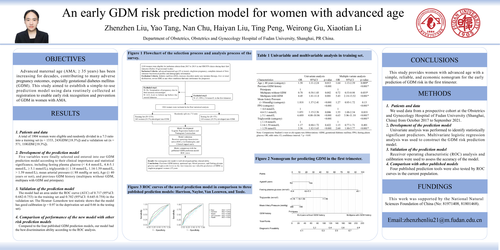
Advanced maternal age (AMA; ≥ 35 years) has been increasing for decades, contributing to many adverse pregnancy outcomes, especially gestational diabetes mellitus (GDM). This study aimed to establish a simple-to-use prediction model using data routinely collected at registration to enable early risk recognition and prevention of GDM in women with AMA.
1. Patients and data
A total of 1904 women were eligible and randomly divided in a 7:3 ratio into a training set (n = 1333, 243GDM [18.3%]) and a validation set (n = 571, 110GDM [19.3%]).
2. Development of the prediction model
Five variables were finally selected and entered into our GDM prediction model according to their clinical importance and statistical significance, including fasting plasma glucose (< 4.4 mmol/L, 4.4-5.1 mmol/L, ≥ 5.1 mmol/L), triglyceride (≤ 1.14 mmol/L, 1.14-1.59 mmol/L, > 1.59 mmol/L), mean arterial pressure (≤ 88 mmHg or not), Age (≥ 40 years or not), and previous GDM history (multipara without GDM, multipara with GDM and primipara).
3. Validation of the prediction model
The model had an area under the ROC curve (AUC) of 0.717 (95%CI: 0.682-0.753) in the training set and 0.702 (95%CI: 0.645-0.758) in the validation set. The Hosmer–Lemeshow test statistic shows that the model has good calibration (p = 0.97 in the deprivation set and 0.66 in the testing set).
4. Comparison of performance of the new model with other risk prediction models
Compared to the four published GDM prediction models, our model had the best discrimination ability according to the ROC analysis.
This study provides women with advanced age with a simple, reliable, and economic nomogram for the early prediction of GDM risk in the first trimester.
This work was supported by the National Natural Sciences Foundation of China (No: 81971408, 81801468).