1,830 posters, 67 videos, 75 audios, 29 topics, 22 sessions, 4,727 authors, 1,697 institutions
ePostersLive by SciGen Technologies S.A. All rights reserved.
RCOG World Congress 2023
June 12 - 14, 2023 | London, UK

EP.0824
Novel Triage System for Non-Emergency Gynecology Surgery in A Resource Limited Setting
Poster Presenter
Authors
Affiliations
Part of Topic
Innovation
Novel Triage System for Non-Emergency Gynecology Surgery in A Resource Limited Setting
Giovana Charite, Caryn Albury, Shamanique Bodie-Williams
Rand Memorial Hospital, Grand Bahama, Bahamas
Objective
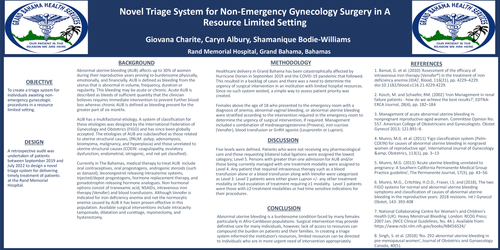
To create a triage system for individuals awaiting non-emergency gynecologic procedures in a resource limited setting.
Design
A retrospective audit was undertaken of patients between September 2019 and July 2022 to design a novel triage system for delivering timely treatment of patients at the Rand Memorial Hospital.
Background
Abnormal uterine bleeding (AUB) affects up to 30% of women during their reproductive years proving to burdensome physically, emotionally, and financially. AUB is defined as bleeding from the uterus that is abnormal in volume, frequency, duration or regularity. This bleeding may be acute or chronic. Acute AUB is described as bleeds of sufficient quantity that the clinician believes requires immediate intervention to prevent further blood loss whereas chronic AUB is defined as bleeding present for the greater part of six months.
AUB has a multifactorial etiology. A system of classification for these etiologies was designed by the International Federation of Gynecology and Obstetrics (FIGO) and has since been globally accepted. The etiologies of AUB are subclassified as those related to uterine structural causes, (PALM: polyp, adenomyosis, leiomyoma, malignancy, and hyperplasia) and those unrelated to uterine structural causes (COEIN: coagulopathy, ovulatory dysfunction, endometrial, iatrogenic, and not yet classified).
Currently in The Bahamas, medical therapy to treat AUB include oral contraceptives, oral progestogens, androgenic steroids (such as danazol), levonorgestrel releasing intrauterine systems, injected/depot progestogens, hormone replacement therapy, and gonadotrophin releasing hormone analogues. Non hormonal options consist of tranexamic acid, NSAIDs, intravenous iron therapy (Venofer) and blood transfusions. Although Venofer is indicated for iron deficiency anemia and not the normocytic anemia caused by AUB it has been proven effective in this population. Available surgical interventions include intracavity tamponade, dilatation and curettage, myomectomy, and hysterectomy.
Methodology
Healthcare delivery in Grand Bahama has been catastrophically affected by Hurricane Dorian in September 2019 and the COVID-19 pandemic that followed. This resulted in a backlog of cases and there was a need to determine the urgency of surgical intervention in an institution with limited hospital resources. Since no such system existed, a simple way to assess patient priority was created.
Females above the age of 18 who presented to the emergency room with a diagnosis of anemia, abnormal vaginal bleeding, or abnormal uterine bleeding were stratified according to the intervention required in the emergency room to determine the urgency of surgical intervention, if required. Management included a combination of medroxyprogesterone (Provera), iron sucrose (Venofer), blood transfusion or GnRH agonist (Leuprorelin or Lupron).
Discussion
Five levels were defined. Patients who were not receiving any pharmacological care and those requesting bilateral tubal ligations were assigned the lowest category; Level 5. Persons with greater than one admission for AUB and/or those being currently managed with one treatment modality were assigned to Level 4. Any patient that required intravenous therapy such as a blood transfusion alone or a blood transfusion along with Venofer were categorized as Level 3. Level 2 patients were either given Lupron +/- any other treatment modality or had escalation of treatment requiring ≥1 modality. Level 1 patients were those with ≥2 treatment modalities or had time sensitive indications for their procedures.
Conclusion
Abnormal uterine bleeding is a burdensome condition faced by many females particularly in Afro-Caribbean populations. Surgical intervention may provide definitive care for many individuals, however, lack of access to resources can compound the burden on patients and their families. In creating a triage system informed the institution’s resources, limited resources can be directed to individuals who are in more urgent need of intervention appropiately.