1,830 posters, 67 videos, 75 audios, 29 topics, 22 sessions, 4,727 authors, 1,697 institutions
ePostersLive by SciGen Technologies S.A. All rights reserved.
RCOG World Congress 2023
June 12 - 14, 2023 | London, UK

EP.0058
Development and validation of software tool for triaging pregnant women at admission
Poster Presenter
Part of Topic
Innovation
Title:
DEVELOPMENT AND VALIDATION OF SOFTWARE TOOL FOR TRIAGE OF PREGNANT WOMEN IN EMERGENCY WARD AT A TERTIARY CARE CENTRE
INTRODUCTION
The process of triaging a pregnant woman is extremely important as the prolonged waiting time may adversely affect maternal and perinatal outcomes. This concept has shifted the focus of obstetric care to include obstetric triage (OT) units. Various studies have shown that reduced waiting at the emergency department actually reduces the duration of stay in hospital, treatment cost and saves hospital resources; This highlights the importance of appropriate utilization of triaging services, especially in Obstetrics. The benefit of triaging is affected in hospitals with a large turnover of patients and reduced manpower at each shift when healthcare workers do it. In places where the health care workers are getting shifted across the health departments within the facility, periodic training and reinforcement will become difficult. This results in inadequate triaging and poor quality of care at ED. Therefore to address this issue and improve the quality of care we intend to develop a user friendly symptoms based software tool and its use in real setting.
AIMS AND OBJECTIVES
At tertiary care centre,
a. To develop and validate a software tool for triaging pregnant women attending obstetric emergency ward
b. To assess the performance of the developed software tool by deploying it in real setting
METHODOLOGY
Study population – All pregnant women attending Obstetric emergency ward at Women and Children Block (WCB) at JIPMER Puducherry
Sampling technique: Non purposive sampling
Sample size- 29 in each category which is 87 (for three colour coded triage) before and after app (Pre & Post implementation) that will be total of 174.
Study duration- 2 months
During first month
Development of app Pre-implementation data
During second month
Post-implementation data Inclusion criteria:•Pregnant women attending emergency department at WCB, JIPMER
•Age > 18 years
Step 1:
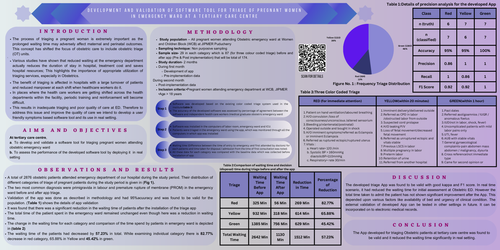
Software was developed based on the existing color coded triage system used in the institute(table 3) The accuracy of the developed software was assessed by percentage of agreement between the software and independent health care workers (medical graduate obstetric emergency ward.
Step 2:
Software was installed in the computers of labor room, emergency ward and ICU. Patients were triaged in the emergency ward using the app, which was monitored through all the computers in which app was installed.
step 3:
Waiting time (Difference between the time of entry to emergency and first attended by doctors) for each patients and time taken for disposal / admission from the time of first consultation was noted. All these data for each category was compared with the baseline data which was collected before installation of app.
OBSERVATIONS AND RESULTS
A total of 2876 obstetric patients attended emergency department of our hospital during the study period. Their distribution of different categories of triage of pregnant patients during the study period is given in (Fig 1).
The two most common diagnosis were primigravida in labour and premature rupture of membrane (PROM) in the emergency ward before and after app triage.
Validation of the app was done as described in methodology and had 95%acuuracy and was found to be valid for the population. (Table 1) shows the details of app validation .
It was found that there was a significant reduction in the waiting time of patients after the installation of the triage app The total time of the patient spent in the emergency ward remained unchanged even though here was a reduction in waiting time.
The change in the waiting time for each category and comparison of the time spend by patients in emergeny ward is depicted in (table 2).
The waiting time of the patients had decreased by 57.23% in total. While examining individual category there is 82.77% decrease in red category, 65.88% in Yellow and 45.42% in green.
DISCUSSION
The developed triage App was found to be valid with good kappa and F1 score. In real time scenario, it had reduced the waiting time for initial assessment at Obstetric ED. However the total time taken to admit the patient has not shown significant improvement after the App. This depended upon various factors like availability of bed and urgency of clinical condition. The external validation of developed App can be tested in other settings in future. It can be incorporated on to electronic medical records.
CONCLUSION
The App developed for triaging Obstetric patients at tertiary care centre was found to be valid and it reduced the waiting time significantly in real setting.