1,830 posters, 67 videos, 75 audios, 29 topics, 22 sessions, 4,727 authors, 1,697 institutions
ePostersLive by SciGen Technologies S.A. All rights reserved.
RCOG World Congress 2023
June 12 - 14, 2023 | London, UK

EP.0085
Novel technique using 3D printing and sound waves to measure intrauterine pressure.
Poster Presenter
Authors
Benjamin Alderson, Hashem Elhossamy, Adel Abdelwahab, Khamis Essa
Affiliations
Part of Topic
Innovation
Novel technique using 3D printing and sound waves to measure
intrauterine pressure.
Contact: Hashem.Elhossamy@NHS.NET
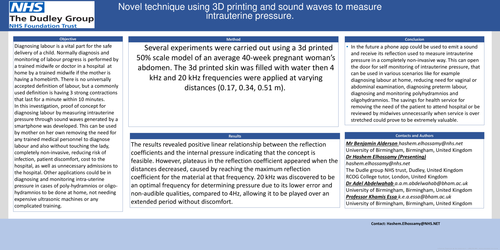
Several experiments were carried out using a 3d printed
50% scale model of an average 40 week pregnant woman’s
abdomen. The 3d printed skin was filled with water then 4
kHz and 20 kHz frequencies were applied at varying
distances (0.17, 0.34, 0.51 m).
Objective
Conclusion
Mr Benjamin Alderson
hashem.elhossamy@nhs.net
University of Birmingham, Birmingham, United Kingdom
Dr Hashem
Elhossamy (Presenting)
hashem.elhossamy@nhs.net
The
Dudle group NHS trust, Dudley, United Kingdom
RCOG College tutor, London, United Kingdom
Dr Adel
Abdelwahab a.a.m.abdelwahab@bham.ac.uk
University of Birmingham, Birmingham, United Kingdom
Professor Khamis Essa
k.e.a.essa@bham.ac.uk
University of Birmingham, Birmingham, United Kingdom
Contacts and Authors
Diagnosing
labour is a vital part for the safe
delivery of a child. Normally diagnosis and
monitoring of labour progress is performed by
a trained midwife or doctor in a hospital at
home by a trained midwife if the mother is
having a homebirth. There is no universally
accepted definition of labour , but a commonly
used definition is having 3 strong contractions
that last for a minute within 10 minutes.
In this investigation, proof of concept for
diagnosing labour by measuring intrauterine
pressure through sound waves generated by a
smartphone was developed. This can be used
by mother on her own removing the need for
any trained medical personnel to diagnose
labour and also without touching the lady,
completely non invasive, reducing risk of
infection, patient discomfort, cost to the
hospital, as well as unnecessary admissions to
the hospital. Other applications could be in
diagnosing and monitoring intra uterine
pressure in cases of poly hydramnios or oligo
hydramnios to be done at home, not needing
expensive ultrasonic machines or any
complicated training.
Method
•
In the future a phone app could be used to emit a sound
and receive its reflection used to measure intrauterine
pressure in a completely non invasive way. This can open
the door for self monitoring of intrauterine pressure, that
can be used in various scenarios like for example
diagnosing labour at home, reducing need for vaginal or
abdominal examination, diagnosing preterm labour ,
diagnosing and monitoring polyhydramnios and
oligohydramnios. The savings for health service for
removing the need of the patient to attend hospital or be
reviewed by midwives unnecessarily when service is over
stretched could prove to be extremely valuable.
The results revealed positive linear relationship between the reflection
coefficients and the internal pressure indicating that the concept is
feasible. However, plateaus in the reflection coefficient appeared when the
distances decreased, caused by reaching the maximum reflection
coefficient for the material at that frequency. 20 kHz was discovered to be
an optimal frequency for determining pressure due to its lower error and
non audible qualities, compared to 4Hz, allowing it to be played over an
extended period without discomfort.
Results