1,830 posters, 67 videos, 75 audios, 29 topics, 22 sessions, 4,727 authors, 1,697 institutions
ePostersLive by SciGen Technologies S.A. All rights reserved.
RCOG World Congress 2023
June 12 - 14, 2023 | London, UK

EP.0788
A case of Heterotopic pregnancy - Lewisham and Greenwich Trust, London.
Poster Presenter
Authors
Affiliations
Part of Topic
Early Pregnancy Complications and Gynaecology
Delayed Diagnosis of Heterotopic pregnancy
Case Report
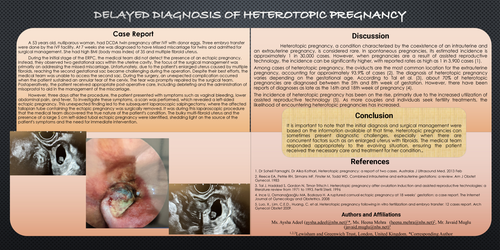
• A 53 years old, nulliparous woman, had DCDA twin pregnancy after IVF with donor eggs. Three embryo transfer were done by the IVF facility. At 7 weeks she was diagnosed to have Missed miscarriage for twins and admitted for surgical management. She had high BMI (body mass index) of 35 and multiple fibroid uterus.
• During the initial stage of the ERPC, the medical team did not detect the presence of an ectopic pregnancy. Instead, they observed two gestational sacs within the uterine cavity. The focus of the surgical management was primarily on addressing the missed miscarriage. Unfortunately, due to the patient's enlarged uterus caused by multiple fibroids, reaching the second gestational sac became challenging during the operation. Despite their best efforts, the medical team was unable to access the second sac. During the surgery, an unexpected complication occurred when the patient sustained an annular tear of the cervix. The tear was promptly repaired by the surgical team. Postoperatively, the patient received appropriate post-operative care, including debriefing and the administration of misoprostol to aid in the management of the miscarriage.
• However, three days after the procedure, the patient presented with symptoms such as vaginal bleeding, lower abdominal pain, and fever. To investigate these symptoms, a scan was performed, which revealed a left-sided ectopic pregnancy. This unexpected finding led to the subsequent laparoscopic salpingectomy, where the affected fallopian tube containing the ectopic pregnancy was surgically removed. It was during this laparoscopic procedure that the medical team discovered the true nature of the patient's condition. The bulky multi-fibroid uterus and the presence of a large 5 cm left-sided tubal ectopic pregnancy were identified, shedding light on the source of the patient's symptoms and the need for immediate intervention.
Discussion
• Heterotopic pregnancy, a condition characterized by the coexistence of an intrauterine and an extrauterine pregnancy, is considered rare. In spontaneous pregnancies, its estimated incidence is approximately 1 in 30,000 cases. However, when pregnancies are a result of assisted reproductive technology, the incidence can be significantly higher, with reported rates as high as 1 in 3,900 cases (1).
•Among cases of heterotopic pregnancy, the oviducts are the most common location for the extrauterine pregnancy, accounting for approximately 93.9% of cases (2). The diagnosis of heterotopic pregnancy varies depending on the gestational age. According to Tal et al. (3), about 70% of heterotopic pregnancies are diagnosed between the 5th and 8th week of gestation. However, there have been reports of diagnoses as late as the 16th and 18th week of pregnancy (4).
•The incidence of heterotopic pregnancy has been on the rise, primarily due to the increased utilization of assisted reproductive technology (5). As more couples and individuals seek fertility treatments, the likelihood of encountering heterotopic pregnancies has increased.
Conclusion
•It is important to note that the initial diagnosis and surgical management were based on the information available at that time. Heterotopic pregnancies can sometimes present diagnostic challenges, especially when there are concurrent factors such as an enlarged uterus with fibroids. The medical team responded appropriately to the evolving situation, ensuring the patient received the necessary care and treatment for her condition..
References
•1. Dr Soheil Farnaghi, Dr Alka Kothari, Heterotopic pregnancy: a report of two cases. Australas J Ultrasound Med. 2013 Feb
•2. Reece EA, Petrie RH, Sirmans MF, Finster M, Todd WD. Combined intrauterine and extrauterine gestations: a review. Am J Obstet Gynecol. 1983
•3. Tal J, Haddad S, Gordon N, Timor-Tritsch I. Heterotopic pregnancy after ovulation induction and assisted reproductive technologies: a literature review from 1971 to 1993. Fertil Steril. 1996
•4. Ince U, Osmanağaoğlu MA, Bozkaya H. A ruptured cornual ectopic pregnancy at 18 weeks’ gestation: a case report. The Internet Journal of Gynecology and Obstetrics. 2008
•5. Luo, X., Lim, C.E.D., Huang, C. et al. Heterotopic pregnancy following in vitro fertilization and embryo transfer: 12 cases report. Arch Gynecol Obstet 2009.
Authors and Affiliations
•Ms. Aysha Adeel (aysha.adeel@nhs.net)1*, Ms. Heena Mehra (heena.mehra@nhs.net)2, Mr. Javaid Muglu (javaid.muglu@nhs.net)3
•1,2,3Lewisham and Greenwich Trust, London, United Kingdom. *Corresponding Author