1,830 posters, 67 videos, 75 audios, 29 topics, 22 sessions, 4,727 authors, 1,697 institutions
ePostersLive by SciGen Technologies S.A. All rights reserved.
RCOG World Congress 2023
June 12 - 14, 2023 | London, UK

EP.0774
Fibroids - A challenge in Early pregnancy
Poster Presenter
Authors
Affiliations
Part of Topic
Early Pregnancy Complications and Gynaecology
Fibroids - A challenge in Early pregnancy
Dr Yik Lam Chan, Miss Myat Pann. Luton & Dunstable University Hospital, Lewsey Road, Luton LU4 0DZ
Introduction
Uterine fibroid is one of the commonest gynaecological conditions in women of childbearing age. Ultrasound examination is generally used as the first line imaging modality in searching for pelvic pathology in pregnant woman due to its high sensitivity and specificity without exposure to radiation. These machines are now widely available and equipped to generate very accurate and high-resolution images compared to 10 years ago. This is undoubtedly very helpful clinically especially in assessing early pregnancy. However, several factors can affect the quality of the images and subsequently lead to difficulty in reaching an accurate diagnosis. We present a case of a 40-year-old patient with interstitial pregnancy in the presence of multiple fibroids that was unable to visualise on ultrasound but diagnosed using MRI and confirmed during surgery.
Objective
To describe the diagnostic challenges and the management of interstitial pregnancy in a patient with multiple large fibroids, where the use of early pregnancy ultrasound is limited.
Pregnancy & Fibroids
Case Report:
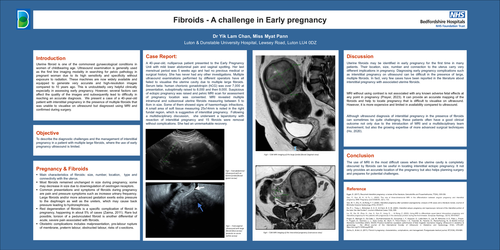
A 40-year-old, nulliparous patient presented to the Early Pregnancy Unit with mild lower abdominal pain and vaginal spotting. Her last menstrual period was 5 weeks ago and had no previous medical or surgical history. She has never had any other investigations. Multiple ultrasound examinations performed by different operators have all failed to visualise the uterine cavity due to multiple large fibroids. Serum beta- human chorionic gonadotropin (hCG) was over 7,000 at presentation, suboptimally raised to 8,000 and then 9,000. Suspicious of ectopic pregnancy was raised and pelvic MRI scan for assessment of pregnancy location was consented. MRI revealed multiple intramural and subserosal uterine fibroids measuring between 5 to 8cm in size. Some of them showed signs of haemorrhagic infractions. A small area of soft tissue measuring 25x14mm is noted in the right fundal region, which is suggestive of interstitial pregnancy. Following a multidisciplinary discussion, she underwent a laparotomy with resection of interstitial pregnancy and 15 fibroids were removal without complications. She had an unremarkable recovery.
Discussion
Uterine fibroids may be identified in early pregnancy for the first time in many patients. Their location, size, number and connection to the uterus carry very different implications in pregnancy. Diagnosing early pregnancy complications such as interstitial pregnancy on ultrasound can be difficult in the presence of large, multiple fibroids. In fact, very few cases have been reported in the literature about interstitial pregnancy with associated uterine fibroids.
MRI without using contrast is not associated with any known adverse fetal effects at any point in pregnancy (Prayer, 2023). It can provide an accurate mapping of the fibroids and help to locate pregnancy that is difficult to visualise on ultrasound. However, it is more expensive and limited in availability compared to ultrasound.
Although ultrasound diagnosis of interstitial pregnancy in the presence of fibroids can sometimes be quite challenging, these patients often have a good clinical outcome not only due to the introduction of MRI and a multidisciplinary team involvement, but also the growing expertise of more advanced surgical techniques (Ho, 2020).
Conclusion
The use of MRI in the most difficult cases when the uterine cavity is completely obscured by fibroids can be useful in locating interstitial ectopic pregnancy. It not only provides an accurate location of the pregnancy but also helps planning surgery and prepares for potential challenges.