1,830 posters, 67 videos, 75 audios, 29 topics, 22 sessions, 4,727 authors, 1,697 institutions
ePostersLive by SciGen Technologies S.A. All rights reserved.
RCOG World Congress 2023
June 12 - 14, 2023 | London, UK

EP.0758
Sepsis and a Diagnostic Dilemma: Retained products of conception or ovarian abscess
Poster Presenter
Authors
Affiliations
Part of Topic
Early Pregnancy Complications and Gynaecology
SEPSIS AND A DIAGNOSTIC DILEMMA: RETAINED PRODUCTS OF CONCEPTION OR OVARIAN ABSCESS
Dr Shehani Alwis MBChB
Dr Sanskiriti Batra MBBS
Mr Kostis Nikopoulous MSc PhD MRCOG Consultant Obstetrician and Gynaecologist / Urogynaecologist
Frimley NHSFoundationTrust
OBJECTIVE
Retained products of conception (RPOC) with concomitant ovarian abscess, has not been reported in literature and can pose a diagnostic dilemma.
CASE REPORT
PRESENTATION
The patient presented with abdominal pain at approximately 6 weeks of gestation. A missed miscarriage was confirmed with two trans-vaginal (TV) ultrasound scans. Following diagnosis, the patient opted for expectant management.
CLINICAL COURSE
4 weeks later she re-presented with vaginal bleeding, fever, abdominal pain and a positive urine pregnancy test.
INVESTIGATIONS
Bloods showed raised inflammatory markers
Ultrasound showed RPOC, left ovarian simple cyst and a right ovarian cyst with hemorrhagic/endometriotic characteristics.
OPERATIVE FINDINGS
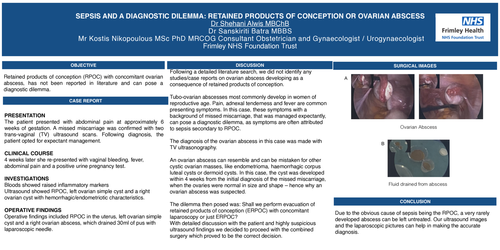
Operative findings included RPOC in the uterus, left ovarian simple cyst and a right ovarian abscess, which drained 30ml of pus with laparoscopic needle.
DISCUSSION
Following a detailed literature search, we did not identify any studies/case reports on ovarian abscess developing as a consequence of retained products of conception.
Tubo-ovarian abscesses most commonly develop in women of reproductive age. Pain, adnexal tenderness and fever are common presenting symptoms. In this case, these symptoms with a background of missed miscarriage, that was managed expectantly, can pose a diagnostic dilemma, as symptoms are often attributed to sepsis secondary to RPOC.
The diagnosis of the ovarian abscess in this case was made with TV ultrasonography.
An ovarian abscess can resemble and can be mistaken for other cystic ovarian masses, like endometrioma, haemorrhagic corpus luteal cysts or dermoid cysts. In this case, the cyst was developed within 4 weeks from the initial diagnosis of the missed miscarriage, when the ovaries were normal in size and shape – hence why an ovarian abscess was suspected.
The dilemma then posed was: Shall we perform evacuation of retained products of conception (ERPOC) with concomitant laparoscopy or just ERPOC?
With detailed discussion with the patient and highly suspicious ultrasound findings we decided to proceed with the combined surgery which proved to be the correct decision.
CONCLUSION
Due to the obvious cause of sepsis being the RPOC, a very rarely developed abscess can be left untreated. Our ultrasound images and the laparoscopic pictures can help in making the accurate diagnosis.