1,830 posters, 67 videos, 75 audios, 29 topics, 22 sessions, 4,727 authors, 1,697 institutions
ePostersLive by SciGen Technologies S.A. All rights reserved.
RCOG World Congress 2023
June 12 - 14, 2023 | London, UK

EP.0757
Complex case of Post Traumatic Vesico-Vaginal Fistula
Poster Presenter
Part of Topic
Urogynaecology/Pelvic Floor
Complex case of Post Traumatic Vesico-Vaginal Fistula
Reem Al Awadhi1, MD; Mennatullah H. Fadda2, MD; Nazeha Al Ghuzi1, MD ; Mona Al Zaabi2, MD; Manal El Redy2, MD; Hossam Ibrahim2,MD
1 Corniche Hospital, Abu Dhabi 2 Sheikh Shakbout Medical City, Abu Dhabi
Objective:
Demonstration of the importance of multidisciplinary team approach in management of a complex case of vesicovaginal fistula (VVF).
Case Report:
Following a motor vehicle accident in 2011, a 36-year old female sustained pelvic fractures and multiorgan injuries leading to a left nephrectomy, splenectomy and left total hip replacement. Patient was following up with neurosurgery for urinary incontinence, impaired gait and sensation of the left lower limb causing
her to be wheelchair bound. She was not a candidate for neurosurgical intervention and was referred to our urogynecology clinic for further assessment of the urinary incontinence. Urogynecology examination was restricted by pubic bone bridging and vaginal narrowing post hip replacement procedure. On observation, there was no urethral urinary leakage, nor concerns of fecal urgency or incontinence. However, there was visible urinary leakage from the vagina which was highly suggestive of a vesicovaginal or urethrovaginal fistula. MRI of the pelvis did not show any evidence of fistula or abnormal communications. Further assessment required the involvement of the orthopedic team to plan a pelvic bone reconstruction procedure to gain access for thorough urogynecological
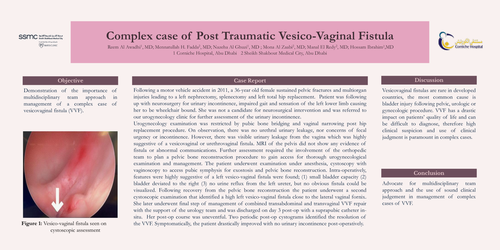
examination and management. The patient underwent examination under anesthesia, cystoscopy with vaginoscopy to access pubic symphysis for exostosis and pelvic bone reconstruction. Intra-operatively, features were highly suggestive of a left vesico-vaginal fistula were found; (1) small bladder capacity (2)
bladder deviated to the right (3) no urine reflux from the left ureter, but no obvious fistula could be visualized. Following recovery from the pelvic bone reconstruction the patient underwent a second cystoscopic examination that identified a high left vesico-vaginal fistula close to the lateral vaginal fornix.
She later underwent final step of management of combined transabdominal and transvaginal VVF repair with the support of the urology team and was discharged on day 3 post-op with a suprapubic catheter insitu. Her post-op course was uneventful. Two periodic post-op cystograms identified the resolution of
the VVF. Symptomatically, the patient drastically improved with no urinary incontinence post-operatively.
Discussion:
Vesicovaginal fistulas are rare in developed countries, the most common cause is bladder injury following pelvic, urologic or gynecologic procedure. VVF has a
drastic impact on patients’ quality of life and can be difficult to diagnose, therefore high clinical suspicion and use of clinical judgment is paramount in complex cases.
Conclusion:
Advocate for multidisciplinary team approach and the use of sound clinical judgement in management of complex cases of VVF.