1,830 posters, 67 videos, 75 audios, 29 topics, 22 sessions, 4,727 authors, 1,697 institutions
ePostersLive by SciGen Technologies S.A. All rights reserved.
RCOG World Congress 2023
June 12 - 14, 2023 | London, UK

EP.0729
Heterotopic pregnancy -a diagnostic dilemma
Poster Presenter
Authors
Affiliations
Part of Topic
Early Pregnancy Complications and Gynaecology
Heterotopic pregnancy – a diagnostic dilemma
Sarosh Khan, Miriam Ali – East Surrey hospital
Introduction
Heterotopic pregnancy is a rare clinical and potentially life-threatening condition in which an intrauterine and extrauterine pregnancy occur simultaneously[1]. The incidence of a spontaneous heterotopic pregnancy is 1 in 30,000 pregnancies[2]. Risk factors for a heterotopic pregnancy include tubal abnormalities secondary to pelvic inflammatory disease or previous surgery[2&3]. Symptoms may include abdominal pain, vaginal bleeding, shoulder tip pain, shock, collapse however some women may be asymptomatic[1].Trans-vaginal ultrasound can diagnose a heterotopic pregnancy however an adnexal mass, especially at early gestations, can be mistaken for a corpus luteum or ovarian cyst[1]. The ectopic pregnancy can be managed expectantly, via aspiration or surgically depending on the clinical picture[1&2]. The intrauterine pregnancy is expected to continue normally[1]. Surgery itself is however can be associated with an increased risk of miscarriage.
Case report
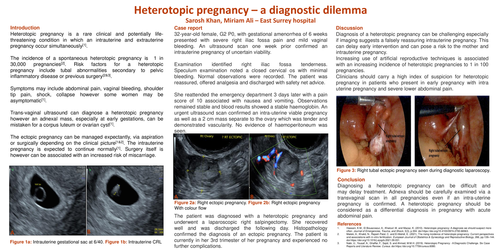
32-year-old female, G2 P0, with gestational amenorrhea of 6 weeks presented with severe right iliac fossa pain and mild vaginal bleeding. An ultrasound scan one week prior confirmed an intrauterine pregnancy of uncertain viability.Examination identified right iliac fossa tenderness. Speculum examination noted a closed cervical os with minimal bleeding. Normal observations were recorded. The patient was reassured, offered analgesia and discharged with safety net advice.She reattended the emergency department 3 days later with a pain score of 10 associated with nausea and vomiting. Observations remained stable and blood results showed a stable haemoglobin. An urgent ultrasound scan confirmed an intra-uterine viable pregnancy as well as a 2 cm mass separate to the ovary which was tender and demonstrated vascularity. No evidence of haemoperitoneum was seen.The patient was diagnosed with a heterotopic pregnancy and underwent a laparoscopic right salpingectomy. She recovered well and was discharged the following day. Histopathology confirmed the diagnosis of an ectopic pregnancy. The patient is currently in her 3rd trimester of her pregnancy and experienced no further complications.
Discussion
Diagnosis of a heterotopic pregnancy can be challenging especially if imaging suggests a falsely reassuring intrauterine pregnancy. This can delay early intervention and can pose a risk to the mother and intrauterine pregnancy.Increasing use of artificial reproductive techniques is associated with an increasing incidence of heterotopic pregnancies to 1 in 100 pregnancies. Clinicians should carry a high index of suspicion for heterotopic pregnancy in patients who present in early pregnancy with intra uterine pregnancy and severe lower abdominal pain.
Conclusion
Diagnosing a heterotopic pregnancy can be difficult and may delay treatment. Adnexa should be carefully examined via a transvaginal scan in all pregnancies even if an intra-uterine pregnancy is confirmed. A heterotopic pregnancy should be considered as a differential diagnosis in pregnancy with acute abdominal pain.
References