1,830 posters, 67 videos, 75 audios, 29 topics, 22 sessions, 4,727 authors, 1,697 institutions
ePostersLive by SciGen Technologies S.A. All rights reserved.
RCOG World Congress 2023
June 12 - 14, 2023 | London, UK

EP.0704
Consider a vault defect with acute pain after pessary insertion
Poster Presenter
Authors
Affiliations
Part of Topic
Urogynaecology/Pelvic Floor
A 77 year old lady presented with severe abdominal pain 2 days after gelhorn pessary insertion. The patient also complained of diarrhoea but was otherwise stable. The patient had a hysterectomy 31 years prior. On examination, the gelhorn pessary was found to be high in the vagina and was removed in theatre under general anaesthetic where a vault defect was identified. The vault was repaired transvaginally with the assistance of general surgeons after conclusion laparoscopic repair for the patient would be high risk. IV antibiotics were prophylactically prescribed for 48 hours.
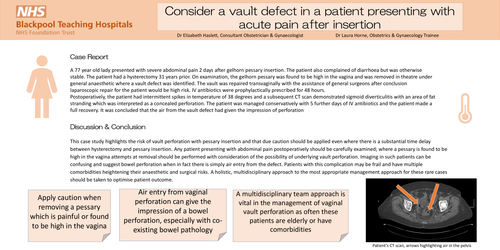
Postoperatively, the patient had intermittent spikes in temperature of 38 degrees and a subsequent CT scan demonstrated sigmoid diverticulitis with an area of fat stranding which was interpreted as a concealed perforation. The patient was managed conservatively with 5 further days of IV antibiotics and the patient made a full recovery. It was concluded that the air from the vault defect had given the impression of perforation
This case study highlights the risk of vault perforation with pessary insertion and that due caution should be applied even where there is a substantial time delay between hysterectomy and pessary insertion. Any patient presenting with abdominal pain postoperatively should be carefully examined; where a pessary is found to be high in the vagina attempts at removal should be performed with consideration of the possibility of underlying vault perforation. Imaging in such patients can be confusing and suggest bowel perforation when in fact there is simply air entry from the defect. Patients with this complication may be frail and have multiple comorbidities heightening their anaesthetic and surgical risks. A holistic, multidisciplinary approach to the most appropriate management approach for these rare cases should be taken to optimise patient outcome.