1,830 posters, 67 videos, 75 audios, 29 topics, 22 sessions, 4,727 authors, 1,697 institutions
ePostersLive by SciGen Technologies S.A. All rights reserved.
RCOG World Congress 2023
June 12 - 14, 2023 | London, UK

EP.0698
Septic Miscarriage due to Fusobacterium Necrophorum Infection - A Case Report.
Poster Presenter
Authors
Affiliations
Part of Topic
Early Pregnancy Complications and Gynaecology
Topic- Septic Miscarriage due to Fusobacterium Necrophorum Infection - A Case Report.
Introduction:
Fusibacterium necrophorum is a strictly anaerobic, Gram-negative, non-spore forming, rod-shaped bacteria
It causes Lemierre’s syndrome and is an unusual cause of early pregnancy loss
The purpose of this case report is to make health professionals aware of the potential of this bacterium causing devastating consequence which caused spontaneous miscarriage at 10wks in a woman who presented with signs of sepsis.
Case History:
A young primigravida, at 10 weeks gestation attended the A&E department of a tertiary care hospital in the North-East of England.
She had a 3day history of crampy lower abdominal pain, heavy vaginal bleeding and fever, interestingly denying any recent sore throat, dyspnoea, dysuria, or urinary frequency.
She had married recently and travelled to the UK
Examination and investigation:
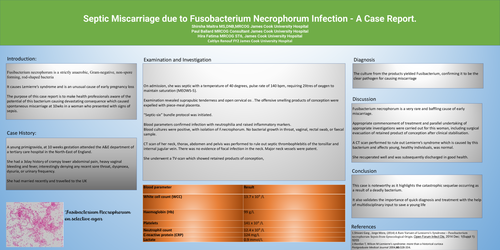
On admission, she was septic with a temperature of 40 degrees, pulse rate of 140 bpm, requiring 2litres of oxygen to maintain saturation (MEOWS-5).
Examination revealed suprapubic tenderness and open cervical os . The offensive smelling products of conception were expelled with piece-meal placenta.
“Septic-six” bundle protocol was initiated.
Blood parameters confirmed infection with neutrophilia and raised inflammatory markers.
Blood cultures were positive, with isolation of F.necrophorum. No bacterial growth in throat, vaginal, rectal swab, or faecal sample.
CT scan of her neck, thorax, abdomen and pelvis was performed to rule out septic thrombophlebitis of the tonsillar and internal jugular vein. There was no evidence of focal infection in the neck. Major neck vessels were patent.
She underwent a TV-scan which showed retained products of conception,
Treatment:
“Septic-six” bundle protocol was initiated
She was commenced on broad spectrum empirical IV antibiotics which were changed to targeted therapy after liaising with Microbiologist. The retained products of conception were surgically removed after stabilising the woman.
She was discharged on oral antibiotics.
Diagnosis:
The culture from the products yielded Fusibacterium, confirming it to be the clear pathogen for causing miscarriage.
Discussion:
Fusibacterium necrophorum is a very rare and baffling cause of early miscarriage.
Appropriate commencement of treatment and parallel undertaking of appropriate investigations were carried out for this woman, including surgical evacuation of retained product of conception after clinical stabilisation.
A CT scan performed to rule out Lemierre’s syndrome which is caused by this bacterium and affects young, healthy individuals, was normal.
She recuperated well and was subsequently discharged in good health.
Conclusion:
This case is noteworthy as it highlights the catastrophic sequelae occurring as a result of a deadly bacterium.
It also validates the importance of quick diagnosis and treatment with the help of multidisciplinary input to save a young life.
References:
1.Shivani Garg , Jorge Mora, (2014) A Rare Variant of Lemierre's Syndrome – Fusobacterium necrophorum Sepsis from Gynecological Origin. Open Forum Infect Dis. 2014 Dec; 1(Suppl 1): S203
2.Riordan T, Wilson M:Lemierre’s syndrome: more than a historical curiosa
Postgraduate Medical Journal 2004;80:328-334.