1,830 posters, 67 videos, 75 audios, 29 topics, 22 sessions, 4,727 authors, 1,697 institutions
ePostersLive by SciGen Technologies S.A. All rights reserved.
RCOG World Congress 2023
June 12 - 14, 2023 | London, UK

EP.0685
Arteriovenous malformation post-surgical management of caesarean section pregnancy
Poster Presenter
Authors
Affiliations
Part of Topic
Early Pregnancy Complications and Gynaecology
Arteriovenous malformation post-surgical management of caesarean section pregnancy
Case Report
Objective: Caesarean section pregnancy has an incidence estimated at 1 in 1800 to 1 in 2226 pregnancies, and in women with previous caesarean delivery accounts for 6.1% of ectopic pregnancies. Caesarean-section pregnancies could be associated with or complicated by an arteriovenous malformation, a life-threatening condition. An arteriovenous malformation is defined as abnormal vascular shunts between myometrium vessels.
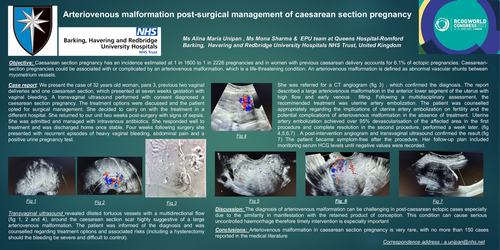
Case report: We present the case of 32 years old woman, para 3, previous two vaginal deliveries and one caesarean section, which presented at seven weeks gestation with vaginal bleeding. A transvaginal ultrasound performed with consent diagnosed a caesarean section pregnancy. The treatment options were discussed, and the patient opted for surgical management. She decided to carry on with the treatment in a different hospital. She returned to our unit two weeks post-surgery with signs of sepsis. She was admitted and managed with intravenous antibiotics. She responded well to treatment and was discharged home once stable. Four weeks following surgery, she presented with recurrent episodes of heavy vaginal bleeding, abdominal pain and a positive urine pregnancy test. Transvaginal ultrasound revealed dilated tortuous vessels with a multidirectional flow around the caesarean section scar, highly suggestive of a large arteriovenous malformation. The patient was informed of the diagnosis and was counselled regarding treatment options and associated risks (including a hysterectomy should the bleeding be severe and difficult to control). She was referred for a CT angiogram, which confirmed the diagnosis. The report described a large arteriovenous malformation in the anterior lower segment of the uterus with high flow and early venous filling. Following a multidisciplinary assessment, the recommended treatment was uterine artery embolization. The patient was counselled appropriately regarding the implications of uterine artery embolization on fertility and the potential complications of arteriovenous malformation in the absence of treatment. Uterine artery embolization achieved over 95% devascularisation of the affected area in the first procedure and complete resolution in the second procedure, performed a week later. A post-intervention angiogram and transvaginal ultrasound confirmed the result. The patient became symptom-free after the procedure. Her follow-up plan included monitoring serum HCG levels until negative values were recorded.
Discussion: The diagnosis of arteriovenous malformation can be challenging in post-caesarean ectopic cases, especially due to the similarity in manifestation with the retained product of conception. This condition can cause serious uncontrolled haemorrhage. Therefore, timely intervention is critical.