1,830 posters, 67 videos, 75 audios, 29 topics, 22 sessions, 4,727 authors, 1,697 institutions
ePostersLive by SciGen Technologies S.A. All rights reserved.
RCOG World Congress 2023
June 12 - 14, 2023 | London, UK

EP.0663
British Criteria for Pregnancies of Unknown Location Applied to Urban American Population
Poster Presenter
Authors
Affiliations
Part of Topic
Early Pregnancy Complications and Gynaecology
Application of British Criteria for Evaluation of Pregnancies of Unknown Location
Introduction
In the United States, pregnancy of unknown location (PUL) is evaluated by measuring 2 serum bhCG value 48 hours apart to determine subsequent management. Declining bhCG levels are often followed down to undetectable levels in current practice. In the British NICE guidelines, a declining bhCG level of 50% or greater is considered low risk for ectopic pregnancy. Serial bhCG measurements are stopped with ectopic precautions and a urine hCG is recommended at 2 weeks. There are no studies to our knowledge evaluating the effectiveness of the British guidelines for managing PUL in an American cohort.
Objectives
1. To investigate the effectiveness of British criteria in excluding ectopic gestation in management of PUL in a multiethnic urban population in the United States.
2. To preliminarily assess cost differential and patient experience differential (measured by number of visits) of both criteria.
Material and Methods
Retrospective study, collection, and statistical analysis of key data points in all patients seen at Jamaica Hospital Medical Center over a 3-year period between January 1, 2019 through December, 31, 2021 with PUL. The study includes patients with initial positive beta hCG but no identifiable intrauterine pregnancy on sonogram and who presented in two days for follow-up.
Results
Of 260 patients evaluated for PUL, 52 (20%) were ultimately diagnosed with ectopic pregnancies, 72% (28%) with intrauterine pregnancies, and 136 (52%) with spontaneous or missed abortions. A greater than 50% decrease in bhCG was identified in 62 (24%) patients and was significantly associated with non-ectopic gestation (p< 0.001). Of these patients, only one patient (1.6%) had an ectopic gestation. The bhCG of the patient with ectopic declined from 649 to 240 in first 48 hours, then rose to 546 at 96 hours. Presumptive diagnosis of ectopic was made, for which methotrexate administered.
There were 1998 total visits and 1020 total bhCG levels drawn, of which 19.4% and 19% were for patients with greater than 50% decline in hCG, respectively.
Conclusions
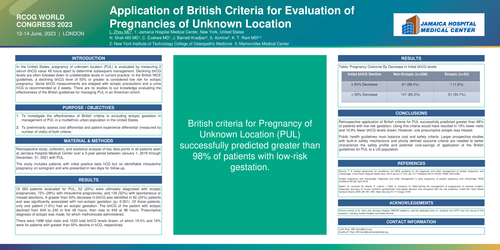
Retrospective application of British criteria for PUL successfully predicted greater than 98% of patients with low-risk gestation. Using this criteria would have resulted in 19% fewer visits and 19.9% fewer bhCG levels drawn. However, one presumptive ectopic was missed.
Public health guidelines must balance cost and safety criteria. Larger prospective studies with built-in safety mechanisms and strictly defined outcome criteria are needed to better characterize the safety profile and potential cost-savings of application of the British guidelines for PUL to a US population.